

13 min read
Cream, Coffee
& Chemistry
How to Make a Baileys Espresso Martini That Actually Works
A Baileys espresso martini sounds simple — cream, coffee, vodka, shake. In practice it is one of the more technically demanding cocktails behind a bar, and most home attempts produce something greasy, separated, or flat. The problem is almost never the ingredients.
The issue is emulsion. Baileys is an oil-in-water emulsion — cream fats suspended in an alcohol-water base. When you shake it with espresso and vodka, you are asking three chemically incompatible phases to coexist in a single glass long enough to drink. Whether they do depends on temperature, shaking technique, ingredient order, and the structural properties of your espresso’s crema. Get those variables right and you get a silky, foam-topped cocktail that holds together for ten minutes. Get them wrong and you get a curdled mess.
This post covers the science — surface tension, viscosity, shear force — and then translates it into a recipe with no guesswork.
⚡ Short Answer
Add Baileys last in the shaker. Use espresso that has cooled 20–30 seconds — warm, not scalding. Shake hard for a full 15–20 seconds. Double-strain into a glass that has been in the freezer. Serve immediately. That sequence solves the separation problem in 90% of cases without touching the recipe itself.
This page is the creamy variation. If you want the classic build first, start with the master espresso martini recipe. If your drink keeps separating or losing its head, the foam science guide explains why.
Get the 21-Day Coffee Glow-Up Recipe Book
Make your morning coffee feel like a treat again: 21 coffee-shop-style recipes you can make at home, with hot, iced, creamy, cozy, and Java Burn-friendly options.
- 21 craveable coffee recipes
- Simple flavor formulas and shopping list
- 7-day coffee glow-up plan
You are in. Grab the recipe book, then check your inbox to confirm the coffee newsletter.
Download the free recipe bookAlready subscribed? Open the recipe book here.
Why readers save it: It gives them recipes first, not hype first. Java Burn stays optional and label-directed, while the download gives them a better coffee routine they can use right away.
What happens next: MailPoet adds them to the Golden Lamb Coffee Newsletter, sends the welcome email, and includes them in the weekly coffee tips nurture sequence.
Educational download. Not medical advice. Java Burn is a dietary supplement; read the label and ask a qualified professional if you use supplements, take medication, or manage a health condition.
The Emulsion Problem,
Explained
Baileys Irish Cream is already an emulsion before it enters the shaker. Its manufacturers use a proprietary blend of emulsifying agents to keep cream fats suspended in an alcohol-water base — which is why it can sit on a shelf for two years without separating. But that existing emulsion becomes fragile once you introduce heat, additional alcohol, and mechanical force. Three variables determine whether your cocktail stays creamy or breaks.
Surface Tension
At a molecular level, water-based liquids resist mixing with fats. The emulsifiers in Baileys reduce this surface tension between the cream and alcohol phases — but that reduction has limits. Introducing undiluted vodka directly against Baileys can momentarily raise the local alcohol concentration enough to stress the emulsion. This is why ingredient order matters: adding Baileys last gives it a partially mixed environment to enter, rather than a high-proof shock.
Viscosity Differential
Baileys is substantially thicker than espresso or vodka. This viscosity gap means that without sufficient shear force, you end up with layers rather than a uniform mixture — dense cream sitting beneath lighter spirits. Hard shaking is not optional here; it is mechanically necessary to overcome the viscosity differential and achieve the uniform droplet distribution that produces smooth texture.
Temperature Gradient
Scalding hot espresso added to cold ice and cream creates an immediate temperature shock that can partially cook the cream proteins and destabilize the emulsion before shaking even begins. Conversely, using ice-cold espresso suppresses the aromatic volatiles and reduces the crema proteins that contribute to foam. The 20–30 second rest after pulling creates the ideal middle temperature — warm enough for chemistry to work, cool enough not to break it.
☕ The Espresso’s Role Beyond Flavor
Fresh espresso crema contains proteins — specifically melanoidins and polysaccharides formed during roasting and extraction. These compounds act as natural surfactants, further stabilizing the emulsion when they interact with Baileys’ own emulsifying agents. This is another reason why cold brew cannot substitute for espresso in this drink: the high-pressure extraction chemistry that creates crema is absent, and with it goes part of the emulsion’s structural support.
The Recipe
& The Ratios
The classic Baileys espresso martini recipe is often written as equal thirds — vodka, Baileys, espresso. That produces a drink that is heavier on cream than most people actually want, and makes the emulsion harder to stabilize. Shifting the ratio slightly toward vodka gives the ethanol more room to help disperse the fat globules and produces a lighter, more cohesive texture.
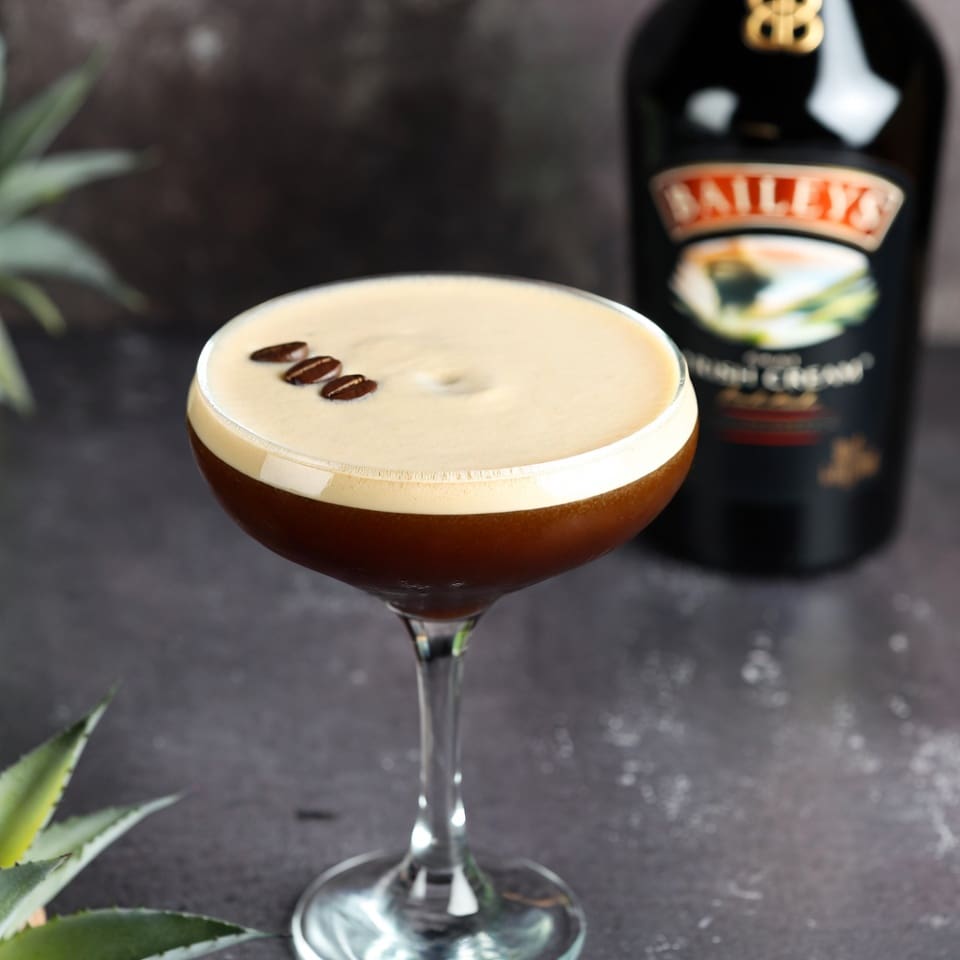
Baileys Espresso Martini
- 1.5 oz vodka (neutral, 40% ABV, chilled)
- 1 oz Baileys Irish Cream
- 1 oz freshly pulled espresso
- ¼ oz simple syrup (optional)
- Ice for shaking
- 3 espresso beans, garnish
- 01
Freeze your glass for at least 5 minutes before starting.
- 02
Pull espresso. Let it rest 20–30 seconds — warm, not scalding.
- 03
Add vodka and espresso to shaker first. Add Baileys last.
- 04
Fill with ice. Shake very hard for 15–20 seconds.
- 05
Double-strain through Hawthorne + fine mesh into chilled glass.
- 06
Three espresso beans. Serve immediately.
🌡️ Why Ingredient Order Matters
Adding Baileys last is not a superstition — it is chemistry. Vodka and espresso mix easily with each other in the shaker before the ice chills them. When Baileys enters that partially mixed, slightly diluted environment, the ethanol concentration it meets is lower than straight vodka would present. Lower local alcohol concentration means less stress on the cream emulsion from the first moment of contact. The difference is subtle but consistent.
When It Goes Wrong —
And How to Fix It
Even with a solid understanding of the chemistry, things go wrong. Here is the diagnostic guide: each problem has a specific cause and a specific fix.
Emulsion Separating in the Glass
Cause: espresso was too hot, or the glass was warm. Fix: rest espresso 30 seconds, chill glass for 5+ minutes in the freezer, and serve immediately. A separated cocktail cannot be rescued — make a fresh one.
No Foam Layer
Cause: under-shaking, or espresso was too old. The foam comes from CO₂ and proteins in fresh crema — both degrade within a minute of pulling the shot. Pull fresh and shake harder, longer. 20 seconds minimum.
Greasy or Oily Texture
Cause: over-creamed ratio (too much Baileys relative to vodka) or insufficient shaking. The 1.5:1 vodka-to-Baileys ratio in this recipe is specifically calibrated to prevent this. If it still feels heavy, reduce Baileys to 0.75oz.
Overly Bitter Finish
Cause: over-extracted espresso — brewed above 205°F or pulled too long. Baileys is sweet but not sweet enough to mask significant bitterness. Pull a shorter shot or add a small simple syrup. Alternatively, use a medium rather than dark roast.
Too Watery or Diluted
Cause: over-shaking, or old, soft ice that melted too quickly. Shake hard but not indefinitely — stop at 20 seconds. Use fresh, hard ice from a full tray. Room-temperature ingredients require more shaking time, which increases dilution.
Flat or One-Dimensional Flavor
Cause: stale beans or pre-ground coffee. The aromatic oils that interact with Baileys’ vanilla and cream notes degrade rapidly after grinding. Use whole beans ground immediately before pulling the shot. The difference is significant.
What Breaks
This Cocktail
- ✗ Adding Baileys first. Pouring Baileys into an empty shaker and then adding vodka creates a momentary high-proof shock that stresses the cream emulsion before shaking even starts. Always add Baileys last, into a partially mixed environment.
- ✗ Using espresso straight from the machine. Fresh-pulled espresso can reach 180°F+. That temperature combined with cold cream and ice creates an immediate phase conflict. The 20–30 second rest drops it to a workable temperature while preserving the crema.
- ✗ Shaking for five seconds and wondering why there is no foam. The shear force required for proper emulsification and foam creation requires sustained effort. Fifteen to twenty seconds is not an exaggeration. Your hand should be genuinely uncomfortable before you stop.
- ✗ Using cold brew, instant, or pre-made espresso. Cold brew lacks CO₂ and crema proteins. Instant lacks the aromatic complexity that creates the flavor interaction with Baileys. Pre-made espresso that has been sitting has lost both. Pull fresh, every time.
- ✗ Skipping the double strain. Single-straining leaves ice chips in the glass that continue melting, diluting the drink progressively and disrupting the foam. Use both a Hawthorne and a fine mesh strainer — it takes three seconds and the result looks and tastes meaningfully different.
Myths Worth
Discarding
Baileys espresso martinis always separate and there is nothing you can do.
✓ RealitySeparation is almost entirely a temperature and technique problem. Correct ingredient order, a 30-second espresso rest, hard shaking, and a cold glass resolve it consistently. The chemistry is manageable.
More Baileys makes the cocktail better — richer and creamier.
✓ RealityPast a certain point more Baileys makes the drink heavy, greasy, and harder to stabilize. The 1:1 Baileys-to-espresso ratio is the ceiling for most palates. Beyond that you are making a dessert shot, not a cocktail.
You do not need fresh espresso — any strong coffee works.
✓ RealityThe crema proteins from fresh espresso are structural to both the foam and the emulsion. Strong drip coffee lacks these entirely. The flavor interaction between espresso’s aromatic oils and Baileys’ vanilla notes also requires fresh extraction chemistry.
The cocktail does not need to be served immediately.
✓ RealityThe foam layer has a lifespan of roughly 3–5 minutes after pouring. The emulsion itself starts breaking down from the moment it hits the glass. This is a drink that must be made and consumed quickly — it is not a set-and-forget pour.
Frequently
Asked Questions
Why does my Baileys espresso martini separate?
Separation happens when the emulsion breaks — usually because the espresso was too hot, the shaking was too brief, or the drink sat too long before serving. Add Baileys last, rest your espresso 20–30 seconds after pulling, shake for a full 15–20 seconds, and serve immediately into a pre-chilled glass.
Do you need vodka in a Baileys espresso martini?
Technically no, but vodka plays a structural role beyond alcohol. Its ethanol helps disperse the fat globules in the cream, which actually aids emulsification. Without it, the drink is richer and heavier — more of a creamy coffee shot than a cocktail. Both are good; they just behave differently.
Should you use cold or warm espresso?
Neither extreme. Scalding espresso destabilizes the cream emulsion immediately. Cold espresso loses aromatic volatiles and produces weaker foam. The ideal is espresso rested 20–30 seconds after pulling — still warm and aromatic, but not hot enough to shock the cream.
Can you make a Baileys espresso martini without an espresso machine?
A Moka pot is a workable substitute — it extracts enough pressure to produce some aromatic oils and partial crema. Cold brew concentrate will not work well: it lacks the crema proteins needed for foam and the volatile aromatic compounds that interact with Baileys. Avoid instant coffee if possible.
What is the best vodka for a Baileys espresso martini?
A clean, neutral 40% ABV vodka — Ketel One, Tito’s, or Grey Goose all work well. Avoid flavored vodkas — they compete with Baileys’ own vanilla and cream notes. The vodka’s job here is structural, not expressive.
⚕️ Note on Caffeine and Alcohol
A Baileys espresso martini contains a full espresso shot (approximately 60–70mg caffeine) combined with multiple spirits. The combination can mask perceived intoxication. Drink responsibly. If you have cardiovascular concerns, caffeine sensitivity, or are pregnant, consult a healthcare professional. This is educational content only.
The Cream Is Not
the Problem
The technique is. And the technique is learnable in a single attempt.
A Baileys espresso martini that separates, goes flat, or tastes one-dimensional is not a sign that the recipe is flawed — it is a sign that one of the emulsion variables was off. Temperature, ingredient order, shaking duration, and glass temperature are the four levers. Fix all four and the chemistry does the rest. Pull your shot, let it rest thirty seconds, add Baileys last, shake until your hand is cold, double-strain into a frozen glass, and serve within two minutes. That is the complete instruction. The creamy, foam-topped cocktail you have been trying to replicate is not a bar secret — it is just physics applied carefully.
Educational content only. Drink responsibly. Consult a healthcare professional for guidance on caffeine and alcohol consumption.
