

13 min read
Coffee Recipes Hub · Equipment & Gear · Buying Guide
Best Quiet
Coffee
Grinders
For peaceful morning brewing
Burr grinders and manual options that won’t wake the house — plus what actually drives grinder noise and which specs matter.
There’s a particular cruelty to a loud coffee grinder at 6 a.m.
The house is still quiet. You’re easing into the day. And then the grinder fires up like a small aircraft engine. Noise is one of the most common complaints among home brewers, and it’s the main reason people start hunting for a better option. This guide covers the best quiet coffee grinders available for home use — breaking down the real differences between types, what actually drives noise, and which specific models are worth buying.
Manual hand grinders are the quietest option — no motor, almost no noise. Among electric grinders, conical burr models with low-speed DC motors are significantly quieter than blade grinders. If you want quiet without giving up convenience, the Baratza Virtuoso+ and Breville Smart Grinder Pro are the two most recommended electric burr grinders for noise-conscious home brewers.
Get the 21-Day Coffee Glow-Up Recipe Book
Make your morning coffee feel like a treat again: 21 coffee-shop-style recipes you can make at home, with hot, iced, creamy, cozy, and Java Burn-friendly options.
- 21 craveable coffee recipes
- Simple flavor formulas and shopping list
- 7-day coffee glow-up plan
You are in. Grab the recipe book, then check your inbox to confirm the coffee newsletter.
Download the free recipe bookAlready subscribed? Open the recipe book here.
Why readers save it: It gives them recipes first, not hype first. Java Burn stays optional and label-directed, while the download gives them a better coffee routine they can use right away.
What happens next: MailPoet adds them to the Golden Lamb Coffee Newsletter, sends the welcome email, and includes them in the weekly coffee tips nurture sequence.
Educational download. Not medical advice. Java Burn is a dietary supplement; read the label and ask a qualified professional if you use supplements, take medication, or manage a health condition.
Why Grinder Noise Matters — and What Causes It
Two variables account for almost all the noise difference between grinder models.
Coffee grinder noise comes from two main sources: motor speed and burr design. Blade grinders spin at very high RPM to chop beans, generating both mechanical noise and heat. Burr grinders — conical or flat — rotate more slowly and grind beans between two abrasive surfaces, which is both quieter and produces a more consistent grind size.
The enclosure matters too. A grinder with a well-fitted hopper, tight housing, and vibration-dampening materials will run noticeably quieter than one that rattles and resonates. Grind time also affects total noise exposure — a faster grinder might be louder per second but done in 8 seconds, while a slower one hums for 20.
Grinder Types Ranked by Noise Level
Three categories with meaningfully different noise profiles — and meaningfully different grind quality.
No motor = near silence. Only a soft rhythmic crunching. Quiet enough to use in a bedroom. The tradeoff: 2–4 minutes of hand-cranking per pot. Ideal for one or two cups at a time.
Significantly quieter than blade grinders. Low-speed DC motors, 60–75 dB range. Far less disruptive than most people expect. Best balance of quiet and convenience for daily brewing.
High-speed chopping blades, 85+ dB, inconsistent grind. The wrong answer for both noise and quality. For the same price or slightly more, a basic burr grinder beats a blade grinder on every meaningful dimension.
What to Look for in a Quiet Coffee Grinder
Before buying, these are the factors that actually change the noise level and daily experience.
-
Burr type: Conical burrs are generally quieter than flat burrs. Their geometry allows for slower motor speeds while still moving beans efficiently. Ceramic burrs run slightly quieter than steel but wear differently over time.
-
Motor speed: Lower RPM motors produce less noise and less heat. Look for grinders marketed with “DC motor,” “low-speed,” or “direct drive” language — these are meaningful signals of quieter operation.
-
Grind settings: More settings means more flexibility across brew methods. Drip, pour-over, French press, cold brew, and espresso all need different grind sizes. A wider range future-proofs your purchase as you try different brewing methods.
-
Hopper and housing fit: Loose parts rattle. A well-built grinder with tight tolerances will always run quieter than one with gaps, loose hoppers, or a lightweight plastic body that resonates during operation.
-
Grind time: Faster isn’t always better if noise is your priority. Some quieter grinders take a few extra seconds per dose — that’s often a worthwhile tradeoff. Look for timer-based or weight-based dosing to keep grind time consistent.
Best Quiet Coffee Grinders Worth Buying
Four specific picks at different price points and use cases — with honest tradeoffs for each.
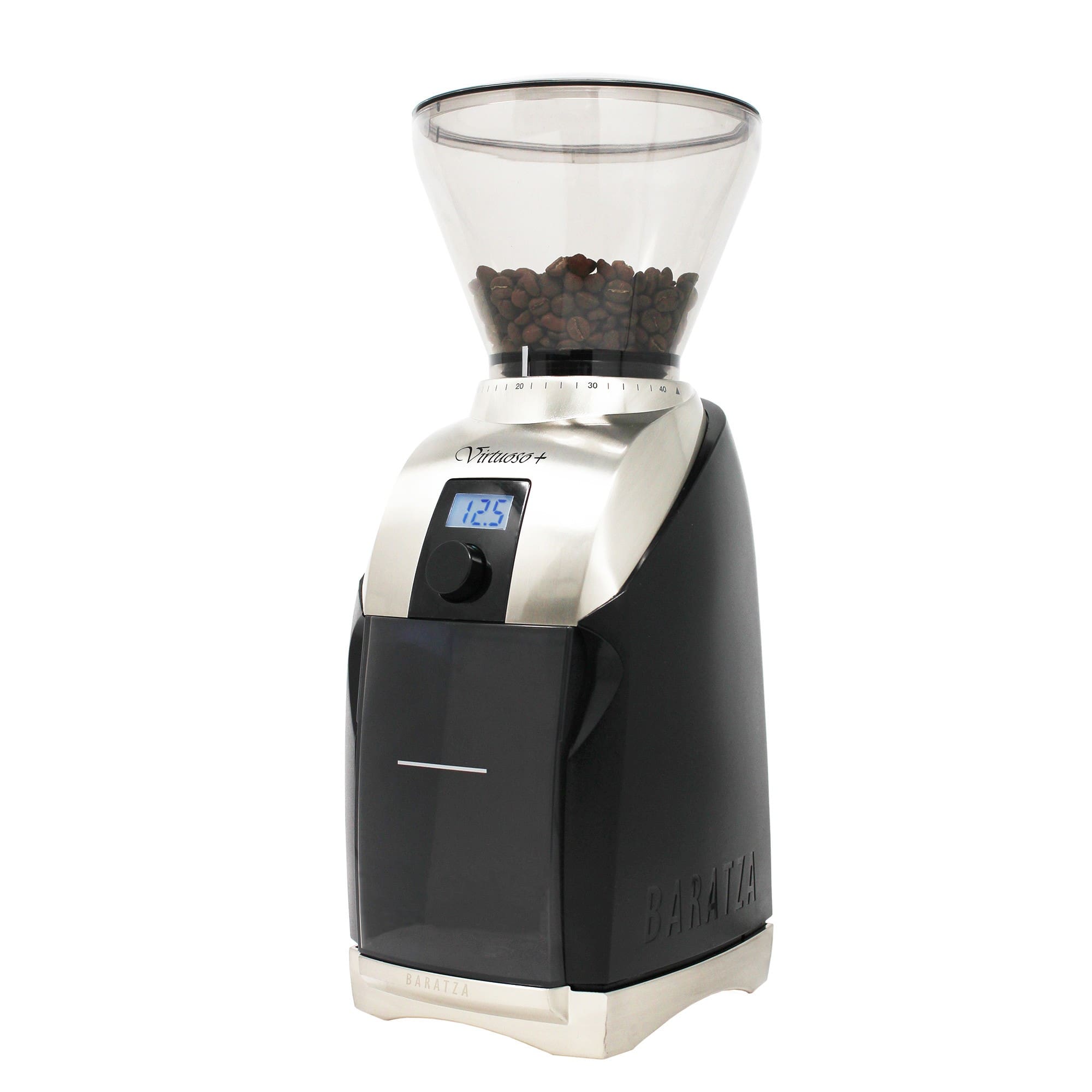
The Baratza Virtuoso+ is the most consistently recommended burr grinder for home use, and its noise level is a genuine selling point. Its DC motor runs at around 550 RPM — lower than many competitors — which keeps the sound profile in the 60–65 dB range. The 40mm conical burrs produce a consistent grind across 40 settings, covering everything from coarse cold brew to medium-fine pour-over.
What sets it apart beyond noise: the build quality and Baratza’s repair program. Most consumer grinders are disposable. Baratza sells replacement parts, offers repair support, and engineers their machines to last years. The digital timer, adjustable to 0.1-second increments, makes consistent dosing effortless — and the LED-lit grounds bin is a small but genuinely useful feature on dark mornings.
Daily drip, pour-over, French press, and cold brew — one grinder for all non-espresso methods
You need precise espresso grinding — the Virtuoso+ can go fine but isn’t optimized for it
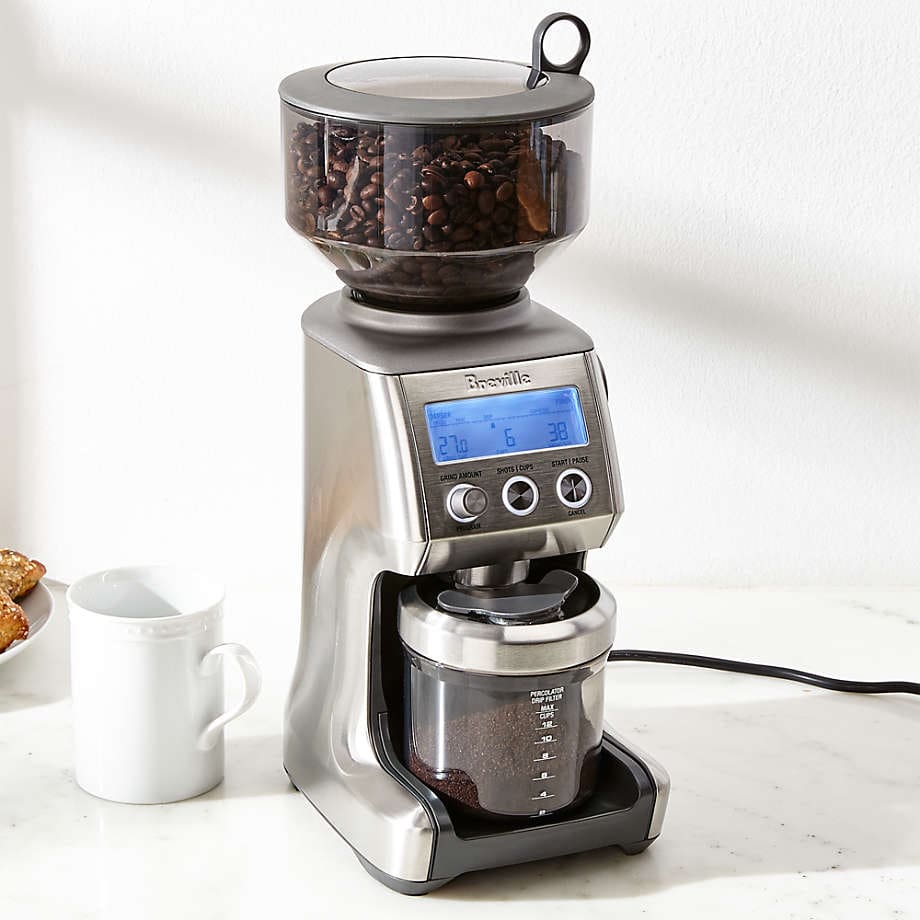
The Breville Smart Grinder Pro offers 60 grind settings, a clear LCD display, and dose-by-time or dose-by-cups functionality. It’s slightly louder than the Baratza Virtuoso+ but still well within the range of a quiet electric grinder. The wide range of settings makes it genuinely versatile — it handles coarse cold brew grinds and fine espresso grinds with equal competence.
The sleek design and intuitive controls make it one of the easier grinders to use when you’re half-awake. Dosing IQ technology automatically adjusts the dose when you change grind consistency — a small detail that eliminates the manual recalibration most grinders require when you switch from drip to espresso settings.
Brewers who want one grinder across multiple methods — including espresso — without buying two separate machines
You want absolute maximum quiet — the Baratza Virtuoso+ runs quieter; the Breville trades some noise for espresso versatility
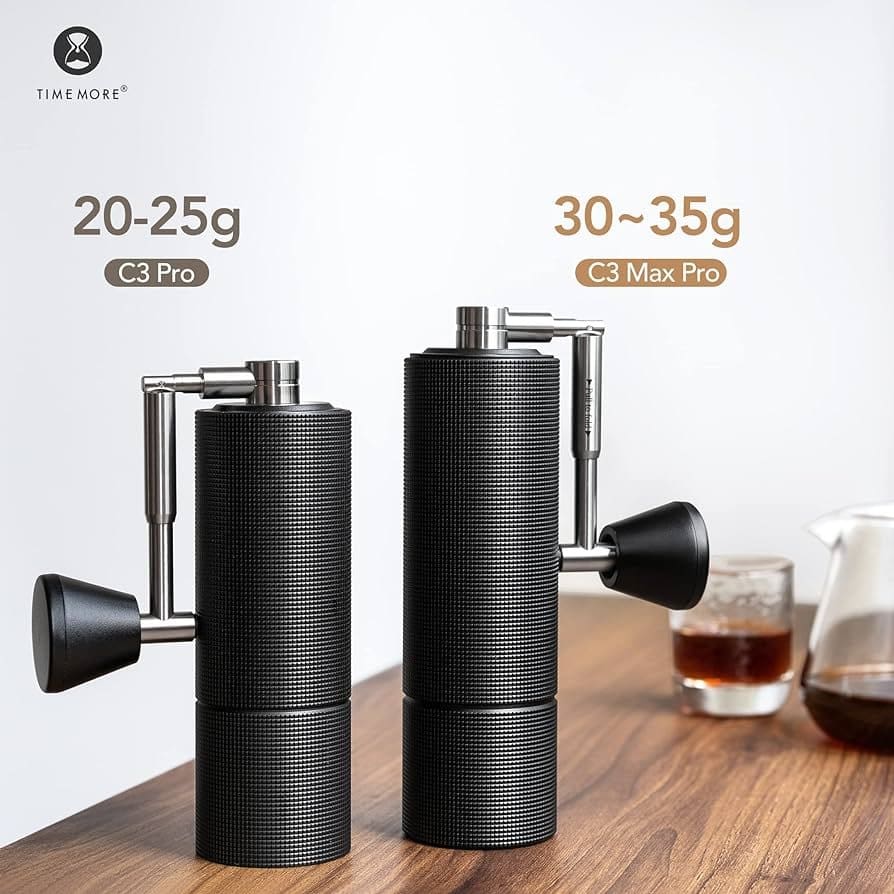
For true quiet, nothing beats a hand grinder. The Timemore C3 and C3 Pro are the most popular entry-level manual grinders for good reason: all-metal construction, hardened steel conical burrs, and a smooth, efficient grinding action that handles one to two cups of drip or pour-over coffee in about two to three minutes of hand-cranking.
The external grind adjustment system makes switching between coarsenesses fast without disassembling the grinder. Build quality is exceptional for the price — it feels more solid than most electric grinders in this range. The only sound during operation is a soft rhythmic crunching that registers well below any ambient noise in a normal room.
One or two cups per morning, travel, minimalists, anyone who genuinely cannot make noise in the morning
You’re brewing for more than two people or want the convenience of a push-button morning routine
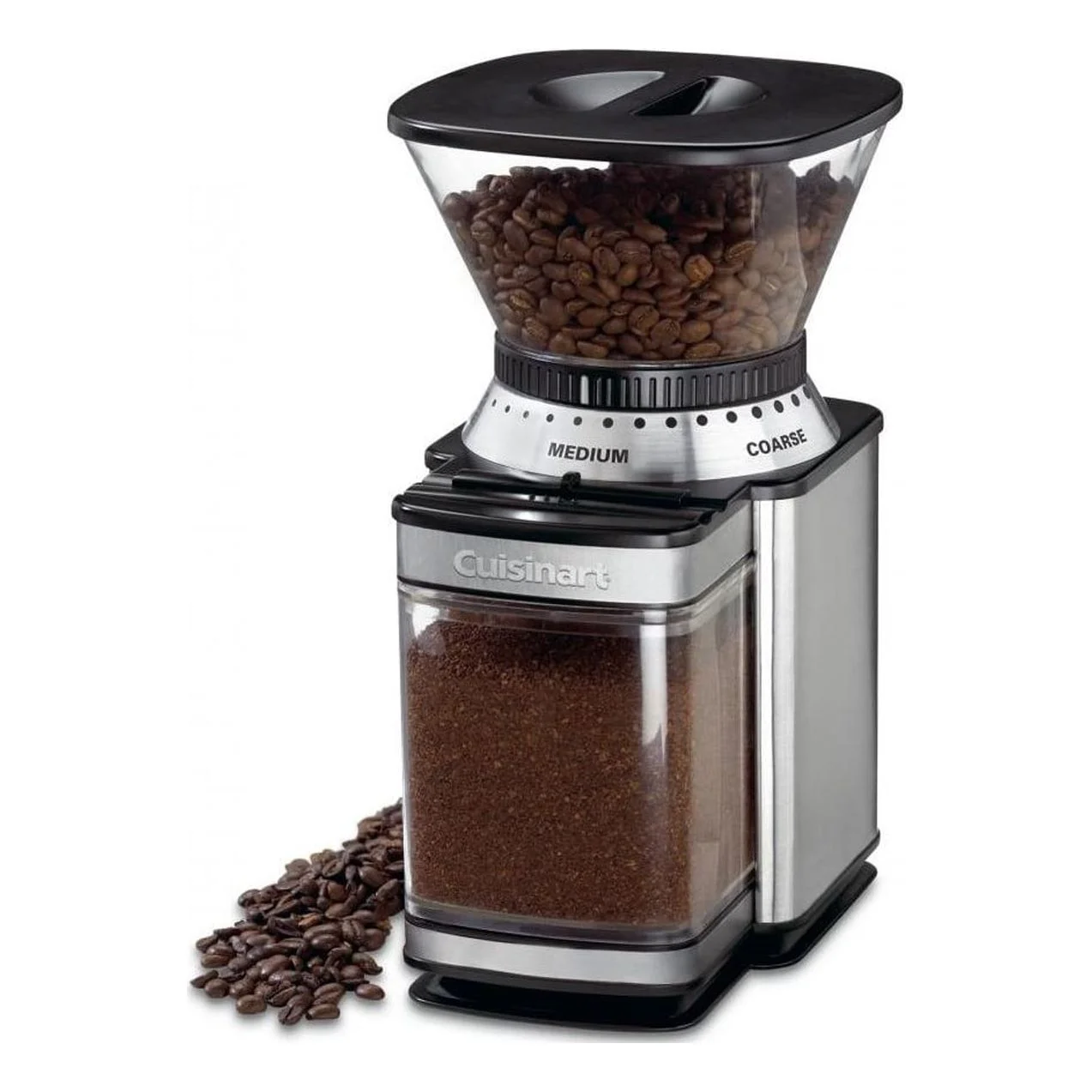
If budget is the primary constraint, look for an entry-level conical burr grinder rather than a blade grinder. Several brands offer basic burr grinders in the $30–$50 range with a handful of grind settings and simple on/off operation. They won’t match the consistency or build quality of the Baratza or Breville, but they’re meaningfully quieter than any blade grinder and produce a better grind.
Manage expectations on longevity — budget burr grinders often use lighter motors and plastic burrs that wear faster with daily use. For occasional brewing or testing whether a burr grinder upgrade makes sense before committing, they’re a reasonable starting point.
Occasional home brewers, dorm rooms, or anyone testing burr grinding before committing to a more expensive model
You grind daily — spend the extra money on the Baratza or Breville, which will last years versus months
Who Should Skip a Quiet Electric Grinder
Quiet electric burr grinders are a smart buy for most home brewers — but not for everyone.
Dedicated espresso enthusiasts who need extremely precise, repeatable grind consistency may find that quieter conical burr grinders don’t dial in tightly enough for single-dose espresso work. Flat burr grinders built for espresso — like the Eureka Mignon series — are louder but significantly more precise at fine espresso grinds.
High-volume brewing for a household of four or more, or for an office environment, requires a machine built for that workload. Consumer-grade quiet grinders aren’t designed for extended daily use at commercial volume. And if you genuinely don’t care about noise, you can get excellent grind quality from louder machines — often at a lower price than the quiet alternatives.
Frequently Asked Questions
Manual hand grinders are the quietest — no motor, near-silent operation. Among electric grinders, conical burr models with low-speed DC motors are significantly quieter than blade grinders, typically operating in the 60–75 dB range.
Yes. Burr grinders operate at lower speeds and use a grinding mechanism between two abrasive surfaces rather than high-speed chopping blades. This produces noticeably less noise and a more consistent grind size — which also improves cup quality.
Relative to most electric grinders, yes. Its DC motor runs at around 550 RPM — lower than many competitors — making it one of the quieter electric burr grinders in its class. It’s not silent, but substantially less disruptive than blade grinders or higher-RPM alternatives.
Some can. The Breville Smart Grinder Pro handles espresso reasonably well with its 60 settings covering ultra-fine grinds. Dedicated espresso grinders tend to prioritize precision over noise — if espresso is your primary use, the Breville SGP is the quieter option that still reaches espresso grind ranges.
Most quality electric burr grinders operate between 60 and 75 dB — roughly the volume of a normal conversation. Blade grinders typically exceed 85 dB, comparable to a blender. Manual hand grinders produce minimal measurable noise, often below ambient room levels.
For single-cup brewing or occasional use, yes — especially if noise is a real concern. The effort is manageable for one or two cups, grind quality from a quality manual grinder like the Timemore C3 is often excellent, and the near-silence is genuine. For high-volume daily brewing, an electric burr grinder is more practical.
Quiet and quality
can coexist.
Manual hand grinders win on noise but require effort. Electric conical burr grinders like the Baratza Virtuoso+ and Breville Smart Grinder Pro offer the best balance of quiet operation, grind consistency, and everyday convenience for most home brewers. Blade grinders should be avoided if either noise or cup quality matters to you.
If you’re grinding for one or two people in the early morning, a quality hand grinder or a low-RPM conical burr electric will make a genuine difference — both in what you hear and what ends up in your cup.
Continue Into the Technical Brewing Hub
Quiet grinders are one practical part of the broader technical brewing workflow. Use these links to connect grinder choice back to extraction and single-dosing strategy.
