

Coffee Equipment · Cleaning Guide
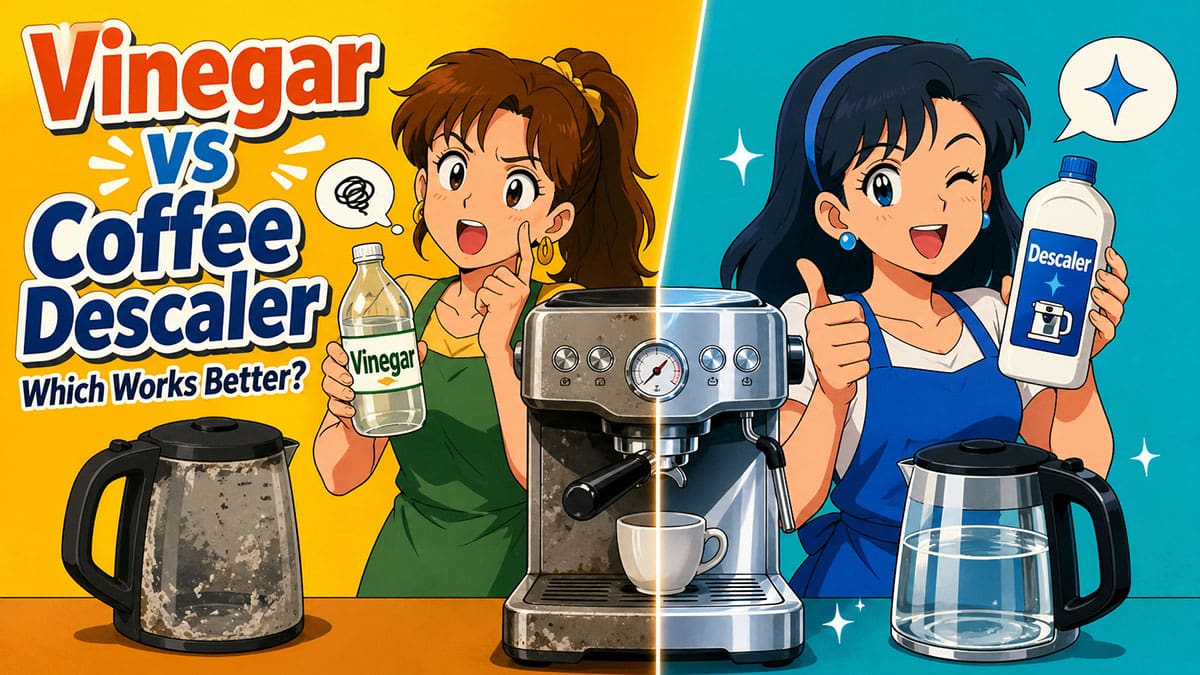
Vinegar vs.
Coffee Descaler
The Scale-Removal Showdown
Both dissolve mineral buildup. Only one was made for your machine.
Mineral buildup is one of the quiet little villains of home coffee brewing.
You might not notice it at first. Your coffee maker still turns on. Water still runs through it. Coffee still comes out. But over time, hard water minerals collect inside the machine — especially in the heating element, tubing, and water reservoir — and that buildup slowly works against you.
Those deposits are usually calcium carbonate and magnesium carbonate. Left alone, they can slow your machine down, make your coffee taste flat or oddly metallic, and shorten the life of your coffee maker. That is where descaling comes in.
The two most common options are white vinegar and commercial coffee descaler. Both can remove mineral buildup, but they are not exactly the same thing. One is cheap and always in the pantry. The other is usually more effective, less smelly, and often safer for routine machine maintenance. So which should you actually use?
Commercial coffee descaler is the better choice for most people. It is more targeted, less smelly, and less likely to leave taste residue. Vinegar can still work for basic machines with light buildup — but check your manual first, because some manufacturers specifically recommend against it.
What Descaling Actually Does
Your machine is not just dirty — it is mineralized.
When water heats up, dissolved minerals separate from the water and stick to internal surfaces. This is especially pronounced with hard water, which contains higher concentrations of calcium and magnesium. Over months and years, those deposits accumulate into a chalky, crusty layer called scale.
Scale can restrict water flow through tubes and valves, insulate the heating element so it has to work harder, interfere with temperature consistency, and leave a flat or slightly off-tasting residue in your coffee. Your machine may start brewing slower, making more noise, or producing coffee that is noticeably less hot than it used to be.
Acid melts the crusty stuff
Descaling uses acid to break down alkaline mineral deposits. When acid contacts calcium carbonate, it reacts to form calcium acetate (or calcium citrate, depending on the acid), water, and carbon dioxide gas. The fizzing you might see or hear during the process is that CO2 being released. The dissolved minerals can then be flushed out with a rinse cycle, leaving the internal surfaces clean.
The type of acid matters. Different acids react with calcium carbonate at different rates, leave different residues, and have different effects on the rubber and metal components inside your machine. That is the core of the vinegar vs. descaler debate.

How Vinegar Works as a Descaler
It is acidic enough. That is genuinely all it takes for light buildup.
White vinegar contains acetic acid, typically around 5% concentration. Acetic acid is a weak organic acid, which means it reacts with alkaline calcium carbonate deposits and helps break them apart. The reaction produces calcium acetate, water, and CO2. For mild scale, that is enough to do a reasonable cleaning job.
Vinegar has real advantages. It costs almost nothing. You almost certainly already have it. And for a basic drip coffee maker with light mineral buildup, a diluted vinegar solution can get the job done without a special product.
But vinegar comes with genuine tradeoffs that are worth knowing before you pour it in.
It smells. A lot. The acetic acid odor can fill your kitchen during a descaling cycle and lingers inside the machine if you do not rinse thoroughly. Nobody wants a cup of coffee with a faint salad-dressing finish. It can leave taste residue. Even with multiple rinse cycles, a faint vinegary taste can persist, especially in machines with small internal tubing. Some manufacturers warn against it. Repeated vinegar use may degrade rubber gaskets, seals, and certain internal metal parts over time. This is more of a long-term concern than a one-time problem, but it is worth checking your manual.
Vinegar is not useless. But it is a general-purpose pantry acid being asked to do a specific coffee-machine job. That mismatch matters more as your machine gets more expensive or more complicated.

How Commercial Descalers Work
Made for this exact job. That formulation difference is real.
Commercial coffee descalers are usually built around citric acid, lactic acid, sulfamic acid, or some combination of these. For drip coffee makers and espresso machines, citric acid and lactic acid are especially common choices.
These acids do the same fundamental thing as vinegar — they react with mineral deposits and dissolve them. But the formulation is optimized for coffee equipment. That typically means a faster reaction with scale, lower odor during use, minimal taste and smell residue after rinsing, and chemistry that is gentler on gaskets, seals, and internal metals when used as directed.
Commercial descalers also come with instructions specifically written for coffee machines. That matters because descaling is not just about removing the scale — it is about removing it without leaving a mess behind or accelerating wear on your machine. The dilution ratios, cycle times, and rinse instructions are all dialed in for the task.
Most commercial descalers cost a few dollars per use, which is more than the effectively zero cost of vinegar, but usually less than the cost of replacing parts or shortening your machine’s life through repeated improper cleaning.
Urnex Dezcal is one of the most widely trusted descalers for home coffee equipment. It is citric-acid based, low odor, effective on heavy calcium buildup, and compatible with most drip coffee makers and espresso machines. Available in powder packets or convenient dissolvable tablets.
Shop Urnex Dezcal on Amazon ->
Vinegar vs. Descaler: Head-to-Head
The biggest difference is formulation. One is made for this. One is not.
- Costs almost nothing
- Already in most kitchens
- Works for mild buildup in basic machines
- Strong smell during and after use
- Can leave taste residue without thorough rinsing
- Some manufacturers explicitly warn against it
- May degrade seals and gaskets with repeated use
- Not ideal for espresso machines or complex brewers
- Made for coffee machines and their components
- Low to no odor during use
- Minimal taste or smell residue after rinsing
- Generally safer for rubber and metal parts
- Better for heavy buildup and regular maintenance
- Includes machine-specific instructions
- Costs a few dollars per use vs. basically free
- Requires buying a separate product
| Factor | White Vinegar | Commercial Descaler |
|---|---|---|
| Active acid | Acetic acid (~5%) | Citric, lactic, or sulfamic acid |
| Odor during use | Strong, sharp | Mild to none |
| Taste residue | Can linger | Minimal when rinsed correctly |
| Machine safety | Varies by brand | Generally safer when used as directed |
| Cost per use | Very low (~$0.10–0.25) | Low–moderate ($1–4) |
| Rinse cycles needed | 2–3 minimum | 1–2 typically |
| Best for | Light scale, basic machines (if manual allows) | Regular maintenance, all machine types |
Rinse cycle requirements may vary by machine and by how concentrated the buildup is.
For most drip machines and home espresso setups, Urnex Dezcal is a safe default. The powder version works well for machines with a larger reservoir; the tablet format is convenient for pod-style or compact brewers. Either way, you get targeted descaling without the vinegar smell or rinsing headache.
Browse Urnex Dezcal on Amazon ->Is Vinegar Safe for Your Machine?
The honest answer: sometimes yes, sometimes no. Check the manual.
Some coffee maker manufacturers allow vinegar. Others specifically recommend against it. This is especially true for machines with internal parts that may be sensitive to prolonged or repeated acid exposure — including certain types of rubber seals, plastic tubing, and aluminum components.
One vinegar cleaning is usually not the problem. The bigger concern is repeated use over months or years, poor rinsing, or letting vinegar sit inside the machine for too long. The acetic acid can slowly degrade certain materials that more targeted descaling acids do not affect the same way at the same concentrations.
If you choose to use vinegar, dilute it to a 1:1 ratio with water, run the descaling cycle per your machine’s instructions, and rinse with at least two to three full cycles of clean water afterward. Brew a hot water cycle as a final check — if you can still smell vinegar, keep rinsing.
If your manual says not to use vinegar, do not use vinegar. That recommendation exists for a reason, and the cost savings are not worth voiding a warranty or damaging a component you cannot easily replace.
Vinegar is fine as an occasional option for basic drip coffee makers when the manual allows it. For anything more complicated — espresso machines, pod brewers, or high-end machines — use the recommended descaler. The smell and taste residue alone make commercial descaler worth it for regular use.

Best Choice by Coffee Maker Type
The right answer depends on what you’re working with.
Basic Drip Coffee Maker
Vinegar Usually OKIf your manual does not prohibit it, diluted white vinegar is a reasonable choice for light maintenance. Inexpensive, effective for mild buildup, and widely available. Still rinse well. Still check the manual first.
Espresso Machine
Use Commercial DescalerEspresso machines have tight pathways, delicate seals, group heads, and solenoids that can be affected by vinegar over time. Use a commercial descaler approved by the manufacturer — Urnex Dezcal works well for most home espresso setups. This is not the place to improvise.
Pod / Single-Serve Machines
Follow Brand InstructionsKeurig, Nespresso, and similar pod machines have brand-specific descaling solutions and dedicated cycles. Keurig officially recommends against vinegar — their descaling solution is widely available. Follow the brand’s guidance — the cycles and rinse times are calibrated for their specific formula.
Specialty & High-End Brewers
Manufacturer Recommendation OnlyIf your coffee maker cost several hundred dollars or more, do not freestyle the maintenance. Use the exact product the manufacturer recommends. The risk of voiding a warranty or damaging a hard-to-replace component is not worth the cost savings of using vinegar instead.

How Often Should You Descale?
Most machines need it more often than most people do it.
For the average home coffee maker used daily, descaling every one to three months is a reasonable starting point. If you have especially hard water, or if you brew multiple pots per day, monthly descaling may make more sense. If you use filtered water and brew infrequently, every three months is probably fine.
Some machines have a built-in descaling indicator that removes all the guesswork. If yours does not, a regular calendar reminder is the practical solution — three months goes faster than you think.
The signs that your machine needs descaling are pretty straightforward: brewing noticeably slower than usual, coffee coming out less hot than it should, more gurgling or noise during the brew cycle, or coffee that tastes flat and a bit dull without a clear explanation from your beans. A faint mineral or metallic note in the cup can also be a tell.
Filtered water can help by reducing the mineral concentration going into the machine, which slows the rate of scale accumulation. It does not eliminate the need to descale, but it can extend the time between cleanings. If you live in a high-hardness water area and have never filtered your water, a basic pitcher filter can make a real difference.

Frequently Asked Questions
What does descaling actually do to a coffee maker?
Descaling uses acid to dissolve mineral deposits that accumulate inside the machine from heated water. Those deposits — primarily calcium and magnesium carbonate — build up on heating elements, tubing, and internal surfaces over time. Removing them restores normal water flow, improves heating consistency, and keeps your coffee tasting clean instead of flat or metallic.
Is vinegar safe for all coffee makers?
Not always. Some manufacturers specifically recommend against it. Vinegar is generally safe for many basic drip coffee makers when properly diluted and thoroughly rinsed, but it can affect rubber seals, gaskets, and some internal components with repeated use. Always check your machine’s manual before using vinegar. If it says not to use it, that guidance exists for a reason.
Can you use vinegar to descale a Keurig or pod machine?
Keurig officially recommends using their own descaling solution, not vinegar. Vinegar can work in a pinch for very light buildup, but the lingering odor is especially noticeable in pod machines, and the brand’s calibrated descaling cycle is designed for their solution specifically. For Nespresso machines, same story — use their recommended descaler and follow their cycle instructions.
How often should I descale my coffee maker?
Most machines benefit from descaling every one to three months, depending on use frequency and water hardness. If you brew multiple pots daily or have hard tap water, monthly descaling makes sense. Signs that it’s overdue include slower brewing, lukewarm coffee, louder-than-usual operation, or a flat, slightly off taste that is not explained by the beans or a dirty carafe.
Does filtered water prevent mineral buildup?
Filtered water reduces mineral concentration and slows the rate of buildup, but most filters do not remove all dissolved calcium and magnesium. You will still need to descale on a regular schedule — just potentially less often than with unfiltered hard water. If you have particularly hard water, a filtered pitcher is worth using consistently.
How do I know if my coffee maker actually needs descaling?
The main signs are a noticeably slower brew cycle, coffee that is less hot than usual, more noise or gurgling during brewing, a dull or slightly mineral taste in the cup, and reduced water flow. If your machine has a descaling indicator light, that makes the timing obvious. If it does not, build a routine — three months is a reasonable default for most households.
Use the Right Tool
for the Machine
Commercial coffee descaler is the better overall choice for most people. It is more targeted, more effective on heavy buildup, easier to rinse, and less likely to leave behind odor or off-flavors in the next cup. If you care about protecting your coffee maker and keeping your brews tasting clean, descaler is worth using on a regular schedule.
Vinegar still has a place. It is cheap, accessible, and can work for basic drip coffee makers with light buildup — as long as the manufacturer allows it. But it comes with real tradeoffs: smell, potential taste residue, and possible compatibility issues depending on the machine.
The safest starting point is simple: check your manual first. Your coffee maker does not need special treatment. It just needs the mineral deposits cleared out without leaving your next cup tasting like it was rinsed in a pickle jar.
