

7 min read
Coffee helps creative work best when it protects attention. The sweet spot is a defined problem, a normal caffeine dose, a distraction-free session, and a second pass after the caffeine peak has settled.
Creativity is not just inspiration. It is attention, energy, pattern recognition, and follow-through. Coffee can support the attention side, while an audio prompt or focus track can act as a cue to start.

What the cup is actually doing
Coffee is more than a flavor preference. Beyond caffeine, it carries a long list of bioactive compounds, and it has been studied for alertness, attention, sleep, and long-term health. The useful question for creative work is narrower: what kind of thinking does caffeine actually help?
Here is the honest answer. Research in Consciousness and Cognition found that a moderate dose of caffeine, around 200 mg, improved convergent thinking, the kind where you hunt for the single right solution to a problem. It did not measurably boost divergent thinking, the free idea generation that feels like brainstorming, and it did not improve working memory. So coffee is a strong tool for solving and finishing, less so for dreaming up the raw idea.
For a broad baseline, the BMJ umbrella review on coffee and health notes that roasted coffee is chemically complex, with antioxidant and anti-inflammatory plausibility. The FDA likewise says caffeine can be part of a healthy diet for most adults, while reminding people that too much can cause side effects.

What caffeine is good at
A few credible references sit behind the problem-solving over idea-generation view of coffee and creative work.
- Convergent thinking
- Consciousness and Cognition — about 200 mg caffeine improved problem-solving, not free idea generation.
- Caffeine + L-theanine
- L-theanine with caffeine — improves attention-switching and resists distraction, with fewer jitters.
- Cognition review
- Caffeine and cognitive functions — systematic review.
- Caffeine limits
- FDA — Spilling the Beans: How Much Caffeine Is Too Much?
What coffee actually supports
A simplified view of how consistent the everyday evidence is, not precise effect sizes. The pattern is the point: coffee sharpens the work you can already see, more than it invents the idea for you.
A simple coffee-first routine
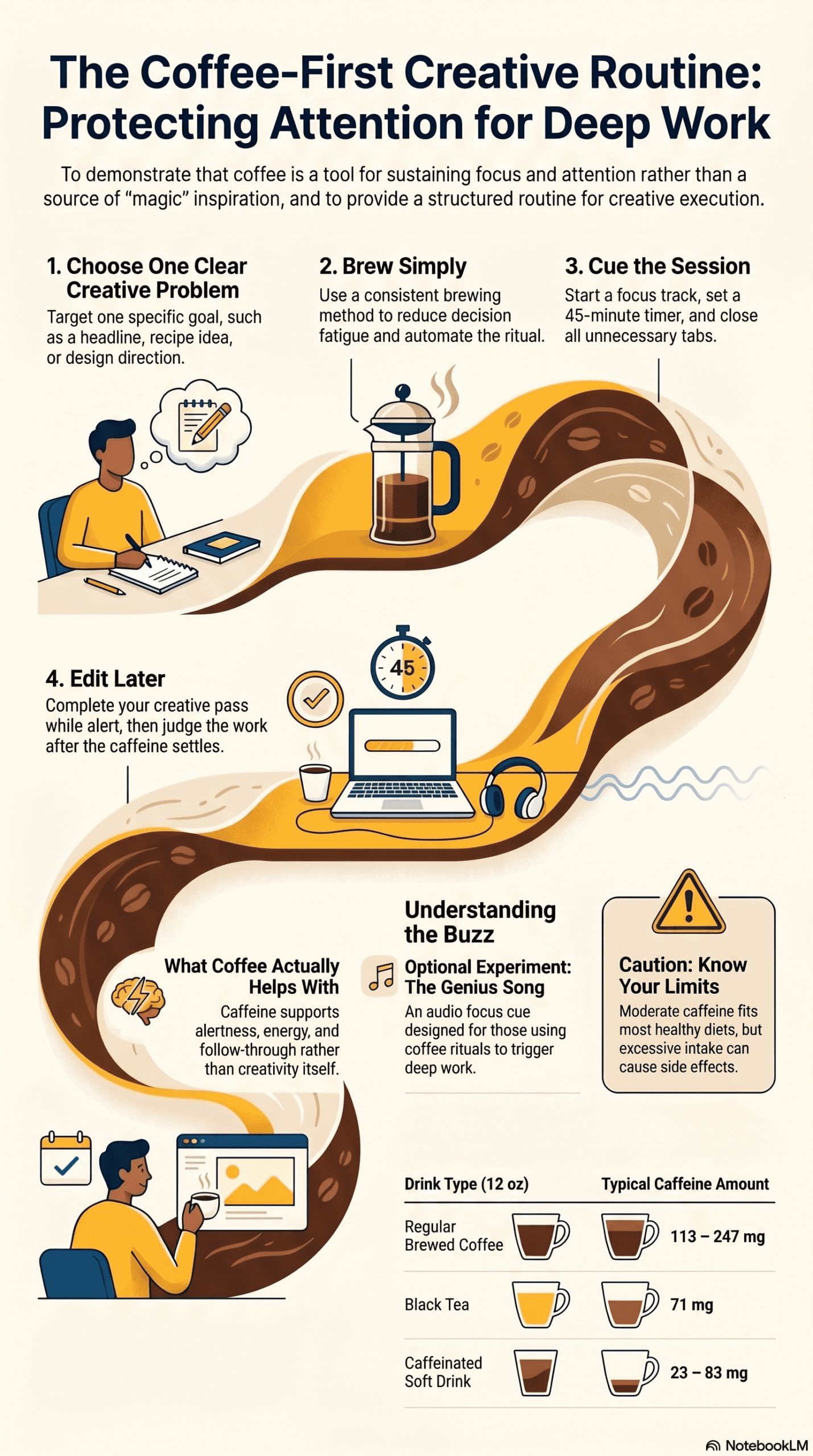
You do not need a system. You need one problem and one session. Here is a map you can run in under an hour.
- Choose the problem One clear creative target
- A headline, an outline, a recipe idea, a photo concept, or a pitch. Pick one.
- Brew simply Avoid decision fatigue
- Use the same coffee method every time so the ritual feels automatic and you spend your energy on the work.
- Cue the session Audio can anchor the habit
- Start your track, set a 45-minute timer, and keep only the tab you actually need open.
- Edit later Protect quality
- Come back after the first burst to judge the work with a calmer brain.
Why a sound cue helps you start
Steady, lyric-free sound gives the brain a stable backdrop instead of a stream of words to process. That is why Baroque pieces by Bach or Vivaldi, ambient tracks, and lo-fi loops all work as focus music: predictable patterns, nothing to sing along to.
Some tools go further with brainwave entrainment, using steady frequencies to nudge the brain toward the calmer alpha and theta states people link with relaxed focus. The Genius Wave is built on that idea. Treat it as a start cue, not a shortcut. The science here is early, and consistency matters more than any single listen.

Coffee and creativity: focus habits compared
Coffee is one lever. Here are the focus aids people pair with it, what each is good for, and where each falls short.
| Habit or tool | Best for | How to use it | Main limitation |
|---|---|---|---|
| L-theanine + caffeine | Calm, focused alertness | About 100 mg L-theanine to 50 mg caffeine (2:1) | Too much L-theanine (5:1) can dull the lift |
| Morning writing | Catching ideas before distractions | One hour, first thing, daily | Needs consistency; pays off slowly |
| Baroque music | Order and calm during deep work | Bach or Vivaldi, 45 to 90 minute blocks | Lyrics or catchy tunes break focus |
| RYZE mushroom coffee | Smoother energy, fewer jitters | One daily cup, about 48 mg caffeine | Costs more; earthy taste takes adjusting |
| Coffeehouse visits | Conversation, debate, fresh input | A visit when you need people and ideas | A social spark, not a solo focus tool |
| Lo-fi hip-hop | An easy, low-stakes backdrop | On loop during focus blocks | Can distract on heavy analytical work |
| The Genius Wave | A start cue for focus sessions | A few minutes daily for 1 to 2 weeks | Hype outruns proof; not skill-building |
A quick history: the Penny Universities
None of this ritual is new. In 17th and 18th century England, coffeehouses were nicknamed Penny Universities: for the price of a penny, anyone could sit, read the day’s news, and argue ideas with strangers. The first opened in Oxford in 1650, London followed in 1652, and the rooms became engines of the Enlightenment.
They were also real places of work. Lloyd’s of London grew out of Lloyd’s Coffee House, and early stock trading found its feet in similar rooms. The pattern holds up: coffee plus a focused room full of intent has been a creativity tool for almost 400 years.
My honest take
I would not buy any wellness or self-improvement product because a sales page sounds dramatic. I would click when the product fits something I am already trying to improve, when the claims are specific enough to check, and when the routine around it is realistic for more than two weeks.
Coffee is the anchor here because it is already part of the morning for many readers. The product is the optional experiment — and the focused session is the part that actually does the work.
Coffee buys you a sharper hour. What you build in the hour is the real creative tool.
Important: the FDA points to about 400 mg of caffeine a day, roughly two to three cups of coffee, as a level not generally tied to problems for healthy adults. Past that, expect jitters, a racing heart, and poor sleep. Decaf is not caffeine-free either, usually 2 to 15 mg per cup.
If you are pregnant, caffeine-sensitive, taking medication, managing a medical condition, or dealing with persistent symptoms, use extra caution. For supplements especially, read the ingredient panel and ask a qualified clinician about interactions.
Helpful related reading
Frequently asked questions
Can coffee make you more creative?
Coffee is better supported for alertness and attention than for creativity itself. But better attention can make creative work easier to start and finish.
When should I drink coffee for creative work?
Many people do well with coffee shortly before the first deep-work block. If coffee makes you anxious, use less or drink it with food.
Is The Genius Wave proven to increase IQ?
I would not frame it that way. It is better to treat it as a focus ritual that may help you start and sustain creative work.
Sources
- Consciousness and Cognition — caffeine, convergent and divergent thinking.
- PubMed — Caffeine and L-theanine cognitive outcomes.
- PubMed — Caffeine and cognitive functions (systematic review).
- BMJ — Coffee consumption and health (umbrella review).
- FDA — Spilling the Beans: How Much Caffeine Is Too Much?
