
5 min read
If you treat Oat Milk like Dairy Milk, you will fail.
You have bought the fancy “Barista Edition” carton. You have the steam wand. But instead of silky micro-foam, you get a cup of hot, watery bubbles that collapse in 10 seconds.
Here’s the deal:
Cow’s milk relies on Whey and Casein proteins to trap air. Oat milk relies on Globulins and added oils. They react to heat completely differently. If you steam oat milk to the standard dairy temperature (70°C), you are destroying the very proteins needed to hold the foam.
In this post, you will learn:
- The Denaturation Point (Why 60°C is the limit).
- How dipotassium phosphate keeps your coffee from curdling.
- Why “Barista Editions” are chemically engineered for latte art.

1. The Protein Problem: Globulins vs. Casein
To get foam, you need surfactants. These are molecules that reduce the surface tension of water and trap air bubbles.
In dairy, Casein micelles are incredibly resilient. You can heat them, beat them, and they stretch. They form a “skin” around the air bubble.
In oats, the primary proteins are Globulins (Avidins). These are globular proteins that are tightly folded. When you introduce steam, you start to unfold them. This is good—unfolding helps them coat the air bubbles.
But here is the catch:
If you heat them past a certain point, they don’t just unfold. They aggregate. They clump together and precipitate out of the solution. The foam structure collapses because the “bricks” of your wall just turned into rubble.

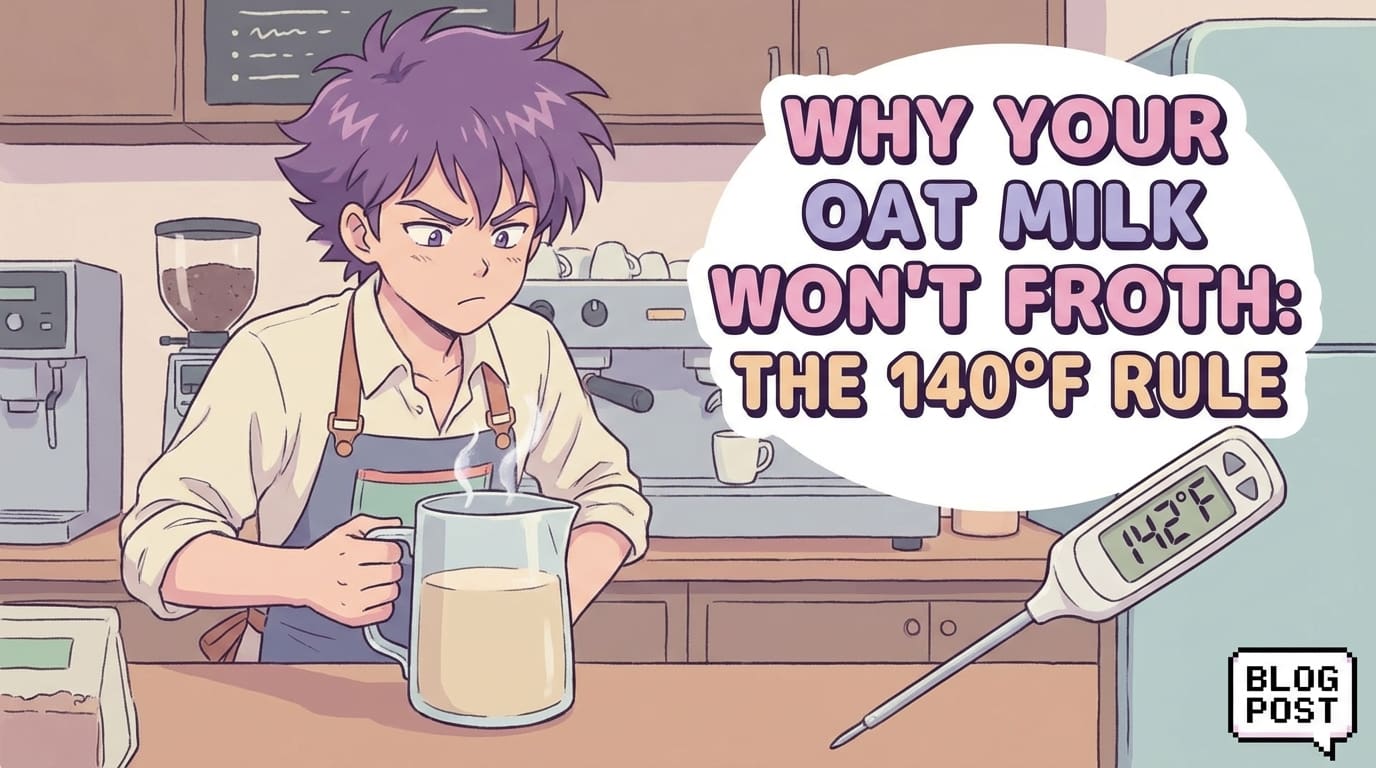
2. The 60°C (140°F) Glass Ceiling
With dairy, you can push to 70°C (158°F) before it tastes “cooked.”
With oat milk, the danger zone starts at 60°C (140°F).
Research shows that beyond this temperature, the viscosity of the oat milk drops drastically. The “creaminess” disappears. The beta-glucans (the fiber) start to lose their lattice structure. You end up with a thin, watery liquid and large, dry bubbles on top.
The Fix: Stop steaming earlier. If the pitcher is “too hot to touch,” you have already ruined it. It should feel pleasantly warm, not hot.
3. The “Barista Edition” Secret Ingredient
Why does Oatly Barista froth, but generic Oat Milk doesn’t?
Fat.
Oats have very low fat content naturally (~1-2%). High-quality foam requires roughly 3% fat to stabilize the bubbles (fat globules sit between the air and water).
Barista editions add Rapeseed (Canola) Oil to mimic the fat content of whole cow’s milk. They also add Dipotassium Phosphate.
Why the phosphate?
Coffee is acidic (pH 5.0). Oat milk is neutral (pH 7.0). When you mix them, the acid shock causes the oat proteins to feather (curdle). Dipotassium Phosphate acts as a buffer. It neutralizes the acid at the point of contact, preventing the “chuncky latte” effect.
4. Deep Dive: Beta-Glucans and Mouthfeel
The one advantage oats have over almonds or soy is Beta-Glucan.
This acts as a hydrocolloid (thickener). It makes the liquid feel creamy without needing as much fat. However, aggressive steaming sheers these long-chain molecules. If you introduce air too aggressively (the “paper tearing” sound for too long), you physically chop up the beta-glucans, losing the texture.
The Technique: Introduce air (stretch) gently for the first 5 seconds only. Then submerge the wand and “roll” the milk to texturize. Do not stretch past 35°C (body temp).
5. FAQ: Oat Milk Troubleshooting
Q: Can I froth oat milk cold?
A: Yes. Cold foam works well because the fat stays rigid. Just use a high-speed blender or Nanofoam.
Q: Why does it separate in my iced coffee?
A: Density. Oat milk is basically water + fiber. Coffee is water. Over time, the fiber settles. Shake it before drinking.
Q: Is the oil bad for me?
A: It is inflammatory vegetable oil. If you are strict paleo/keto, avoid Barista editions. But don’t expect good foam.
6. Recommendation: The Best Brand
We have tested them all. Califia Farms, Minor Figures, Chobani.
Oatly Barista Edition (Grey Carton) is still the king. The chemistry is perfectly balanced between protein stability and phosphate buffering. It is nearly impossible to curdle.
Minor Figures is a close second, but lighter. Better for delicate washed coffees.
QUICK SUMMARY: The 60°C Rule
- 🌡️ Temp: Stop at 140°F (60°C).
- 🧪 Additives: Must have Dipotassium Phosphate suitable for coffee.
- 🌪️ Technique: Short stretch, long roll.
7. The Final Pour
Stop blaming your steam wand. The physics of plant protein are limited.
Respect the thermal limit. Keep it warm, not hot. Your tongue (and your latte art) will thank you.
References
- Frontiers in Food Science. (2024). “Effect of Heat Treatment on… Milk Proteins”. Link.
- Rheology Lab. (2023). “Oat Milk Foam Stability Analysis”. Link.
8. The Environmental Truth
Why is Oat Milk taking over the world? Sustainability.
Water Usage per Liter:
- Dairy: 628 Liters
- Almond: 371 Liters
- Oat: 48 Liters
Oats are a cover crop. They grow in temperate climates (like Canada and Sweden) where rain is abundant. They don’t require the massive irrigation of California almonds.
9. The Glycemic Spike: The Dirty Secret
Oat milk is delicious because it is sugar.
During production, enzymes (amylase) are added to break down the oat starch into maltose (sugar). This makes it sweet without adding “Table Sugar.” However, Maltose has a Glycemic Index (GI) of 105. That is higher than pure glucose (100).
When you drink an Oat Latte, you are spiking your insulin harder than if you ate a Snickers bar. If you are diabetic or Keto, Oat Milk is dangerous. Stick to Almond or Dairy.
10. Why You Can’t Make It At Home
We have all tried. You blend oats and water. You strain it.
Result: Slimy, separated gray water.
Commercial Oat Milk uses enzymatic hydrolysis to liquefy the oats without making them slimy. They also use homogenizers running at 3000 PSI to emulsify the oil and water. Your Vitamix cannot replicate 3000 PSI. Don’t waste your time. Buy the carton.
11. The Final Pour: Tolerance vs. Taste
Oat milk is not a health food. It is a highly processed glucose syrup with added oil. But, it is the only plant milk that tastes good in coffee.
If you are vegan for ethical reasons, it is the gold standard. If you are drinking it for health, you might want to reconsider. But if you just want a creamy latte without the cow, keep your thermometer at 60°C, buy the Barista Edition, and enjoy the foam. Just don’t pretend it’s kale.
