
5 min read
The days of “100% Arabica” snobbery are over.
For 50 years, marketing campaigns convinced us that Arabica = Good and Robusta = Bad. They were right… back then. Robusta tasted like burning rubber.
Here’s the deal:
Climate change is coming for Arabica. It is fragile. Robusta is the tank of the coffee world. Farmers in Vietnam have spent the last decade genetically improving the species. The result? “Fine Robusta” that tastes like Scotch, dark chocolate, and hazelnuts.
In this post, you will learn:
- Why Italian espresso has always used a 40:60 ratio.
- The Crema Factor (Robusta makes more foam).
- The 2025 Fine Robusta trends from Vietnam.

1. The Biology: Survival of the Fittest
Arabica grows at high altitudes (cool temps). Robusta grows at sea level (hot temps).
Because Robusta evolved in bug-infested lowlands, it developed a defense mechanism: Caffeine. Robusta has 2x the caffeine of Arabica. Caffeine is technically a pesticide.
This biology creates the flavor profile. Arabica, safe in the mountains, puts energy into sugar production (sweet/fruit). Robusta puts energy into armor (bitter/strong).

2. The 40:60 “Italian Blend” Comeback
If you go to Naples, you don’t drink fruit juice. You drink syrup.
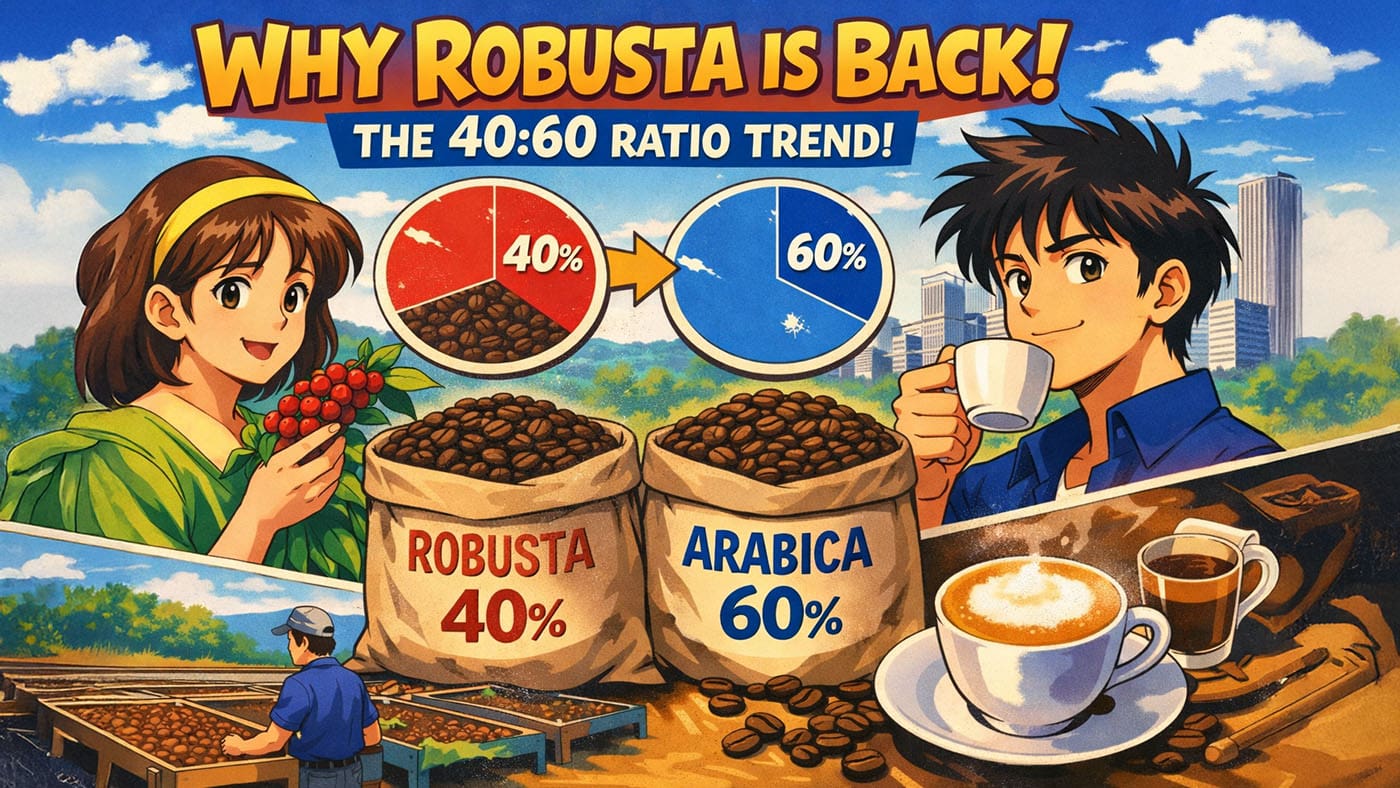
Southern Italian espresso has traditionally been a blend of 60% Arabica (for aroma) and 40% Robusta (for body and kick). The Third Wave movement (Blue Bottle, Intelligentsia) killed this style in the US, demanding pure single-origin Arabica.
But in 2025, the pendulum is swinging back. Customers are tired of sour, tea-like espressos. They want a Cappuccino that tastes like coffee, not hot milk. The 40% Robusta cuts through the fat of oat milk perfectly.
3. The Crema King
Why does Robusta make better latte art?
Crema is CO2 trapped in oil. Robusta beans produce significantly more CO2 during roasting and have less lipid content (oil). Wait, less oil?
Actually, Robusta produces a thicker, more stable crema structure because of its protein matrix. It creates that “Guinness Effect” foam that lasts for minutes. Pure Arabica crema often dissipates in seconds.
4. Vietnam: The New Specialty Frontier
Vietnam is the #1 producer of Robusta. For years, they sold cheap commodity beans for instant coffee.
Now, a new generation of farmers (Gen Z) is applying “Specialty” processing to Robusta. They are doing anaerobic fermentations, honey processing, and meticulous sorting.
The result involves tasting notes of Black Sesame, Dark Rum, and Cacao Nibs. It is deep, savory, and intense. It is the whiskey drinker’s coffee.
5. Deep Dive: Nguyen Coffee Supply
The brand leading this charge in the US is Nguyen Coffee Supply.
They import 100% fine Robusta from Vietnam. Their “Truegrit” bean has 2x slightly more caffeine and 60% less sugar than Arabica. It is marketed not just as coffee, but as “Energy.”
This rebranding is working. In a world of focus-hacking and productivity, Robusta is the ultimate nootropic fuel.
6. Expansion: The Climate Hedge
We have to talk about Global Warming.
By 2050, 50% of current Arabica land will be unsuitable for growing coffee. It will be too hot. Robusta loves the heat.
Investing in Fine Robusta isn’t just a flavor trend; it is an agricultural necessity. If we don’t learn to love Robusta, we won’t have coffee in 30 years. Period.
7. The Price Arbitrage
A high-end 88-point Arabica might cost $30/lb.
A high-end 88-point Fine Robusta costs $18/lb.
For the consumer, this is a massive win. You get “Specialty” quality grading (zero defects, perfect roast) for the price of a supermarket blend. It is the best value in the coffee aisle right now.
QUICK SUMMARY: Why Switch?
- ⚡ Energy: 2x Caffeine.
- 💰 Value: Cheaper for high quality.
- 🌍 Future: Climate resilient.
Final Takeaway: Respect the Hustle
Robusta is the working class hero of coffee. It works harder, survives longer, and punches harder. Don’t look down on it. It might just wake you up better than your delicate floral tea-juice ever could.
References
- Nguyen, S. (2024). “The Future of Fine Robusta”. Daily Coffee News. Link.
- Perfect Daily Grind. (2025). “Robusta Trends: Processing and Fermentation”. Link.
8. The Phin Filter: Respect the Tool
You cannot brew Fine Robusta like a Hario V60 lightweight.
Robusta needs a slow, highly pressurized drip. The traditional Vietnamese Phin Filter is a gravity-press system. It combines the steeping of a French Press with the drip of a V60. It takes 5-7 minutes to brew 4 ounces.
This long contact time allows the thick, viscous oils to extract completely. If you brew it fast (like a Chemex), it will just taste bitter. You need the time to unlock the chocolate notes.
9. Grading: The Q-Robusta Standard
Arabica has “Q-Graders.” Robusta now has “R-Graders.”
The scoring system is different. In Arabica, we look for Acidity. In Robusta, we look for Salt/Savory Balance.
A defect in Arabica is “Sour.” A defect in Robusta is “Rubbery” or “Phenolic.” A high-scoring R-grade coffee will have zero rubber notes. It will taste like toasted grain, caramel, and arguably, peanut butter.
10. Caffeine Titration
Robusta acts differently in the brain.
Because the caffeine content is so high (2.7% vs 1.2%), you cannot drink 3 cups. You will have a panic attack.
The Strategy: Treat it like Espresso, even if brewed as drip. Drink 4-6oz servings. Do not drink a 12oz mug. The half-life of caffeine is 6 hours; a Robusta bomb at 4 PM means you aren’t sleeping until 2 AM.
11. The Home Blender’s Guide
You don’t have to go 100% Robusta immediately.
Start by making your own “Super Bar” blend. Buy a bag of high-quality Arabica (e.g., Ethiopia Yirgacheffe) and a bag of Fine Robusta (e.g., Nguyen Supply). Mix them 80/20.
You will notice the crema gets thicker. The body gets heavier. The caffeine kick hits harder. Slowly increase the Robusta ratio until you find your sweet spot. For many, it’s right at 40%—the perfect Italian standard.
12. The Future is Robust
We are witnessing a changing of the guard.
Arabica had a good run. It is delicate, floral, and fussy. Robusta is the coffee of the 21st century: resilient, bold, and unapologetic. It is time to stop looking at it as the “ugly cousin” and start treating it as the savior of our morning ritual.
