
6 min read
Wondering how much ground coffee you get from 1 cup of whole beans? Get the exact conversion, the golden ratio for brewing, and tips for measuring by weight or volume.
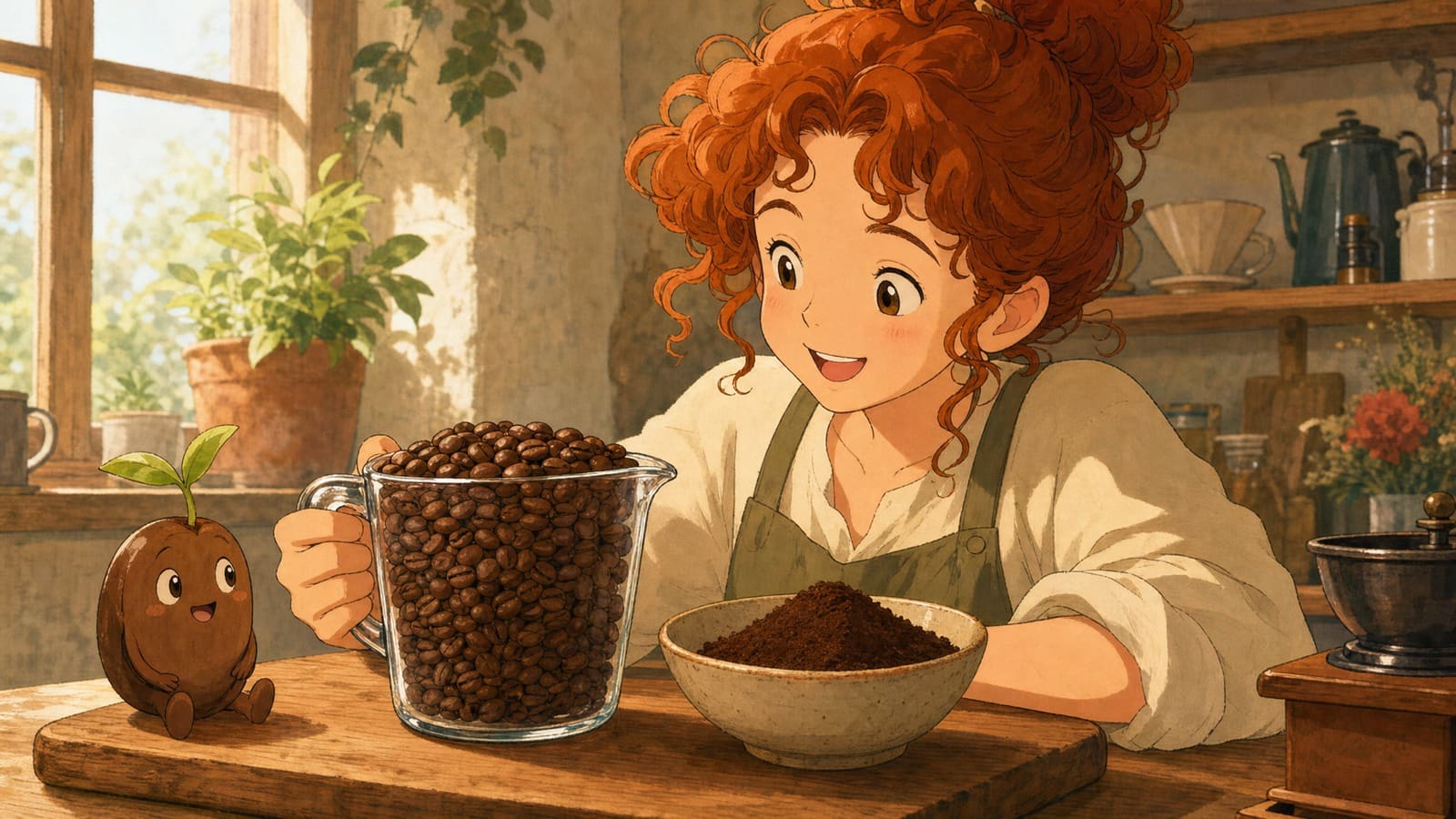
If you grind your own beans, you’ve probably stood at the counter wondering whether to measure before or after grinding — and whether it even matters. It does. Whole beans and ground coffee behave differently in a measuring cup, and knowing the conversion saves you from a weak pot or an accidentally intense brew. So: 1 cup coffee beans equals how much ground coffee? The short answer is almost exactly 1 cup — but the details are worth understanding before you start scooping.
Quick Answer: The Whole Bean to Ground Coffee Conversion
One cup of whole coffee beans yields roughly 1 cup of ground coffee. The volume stays nearly the same because grinding breaks the beans into smaller particles that settle and pack together, offsetting the air space that existed between whole beans. In practice, you might end up with a tablespoon or two less ground coffee depending on grind size and how tightly the grounds settle, but the difference is small enough that a 1:1 volume swap is a reliable working rule.
If you’re measuring by weight — which is more accurate — one cup of whole beans weighs approximately 85 grams, and grinding doesn’t change the weight at all. A gram of coffee is a gram of coffee, before and after the grinder.
Why the Volume Changes When You Grind

Whole beans have irregular shapes with significant air gaps between them. When you grind them, the resulting particles are smaller and more uniform, so they pack more efficiently. A finer grind packs tighter and can reduce apparent volume slightly more than a coarse grind. A coarse grind for French press will look closer in volume to the original whole beans; an espresso-fine grind may compact noticeably more.
This is why kitchen scales are the most reliable tool for coffee measurement. Volume measurements in tablespoons or cups introduce variability that weight simply doesn’t.
The Golden Ratio — How Much Coffee Per Cup of Water?
The Specialty Coffee Association of America established what’s commonly called the golden cup standard: roughly 1 to 2 tablespoons of ground coffee per 6 fluid ounces of water, or more precisely, about 10 grams of coffee per 6-ounce cup. This ratio produces a balanced, well-extracted brew and is a useful starting point for any drip coffee maker or manual method.
Using Tablespoons
For a standard 12-cup drip coffee pot (where each “cup” is 6 ounces, totaling 72 fluid ounces of water), the golden ratio calls for 12 to 24 tablespoons of ground coffee — roughly ¾ to 1½ cups. Most home brewers land comfortably in the middle. If your coffee tastes thin, add a tablespoon. If it’s too intense, pull back.
A standard coffee scoop holds about 2 tablespoons, so one scoop per 6-ounce cup is a practical shorthand.
Using a Scale (the Better Method)

Weight-based brewing removes the guesswork entirely. The widely used ratio is 1:15 to 1:17 coffee to water by weight — meaning 1 gram of coffee for every 15 to 17 grams (or milliliters) of hot water. For a single 8-ounce cup (roughly 240 ml of water), that works out to about 14 to 16 grams of ground coffee.
A coffee scale doesn’t need to be expensive. Even a basic kitchen scale accurate to 1 gram will make a noticeable difference in consistency, especially if you’re dialing in a new brewing method.
Does Grind Size Affect How Much Ground Coffee You Get?
Not by weight — but by volume, yes, slightly. As noted above, a finer grind settles more densely than a coarse one. This matters more for measurement than for yield. The actual mass of ground coffee is identical to the mass of whole beans you started with, regardless of how fine or coarse you grind.
Where grind size makes a big difference is in extraction and brewing time. A finer grind increases the surface area exposed to hot water, which speeds extraction. Use too fine a grind for your brewing method and you’ll over-extract, producing bitterness. Use too coarse and you’ll under-extract, producing sourness or flatness. Match the grind to the method: coarse for French press, medium for drip, fine for espresso.
How to Measure Coffee Without a Scale

If you don’t have a scale handy, the tablespoon method works well enough for everyday brewing:
- Measure whole beans by volume using a measuring cup before grinding.
- Grind them, then use the ground coffee as-is — the volume will be close enough to the same.
- Alternatively, measure ground coffee directly with a tablespoon or coffee scoop after grinding.
- Adjust based on taste: stronger coffee means more grounds or less water; weaker means the reverse.
The key is to be consistent. Once you find a ratio that works for your palate and your drip coffee maker, stick with the same measuring method every time.
Frequently Asked Questions
Does 1 cup of coffee beans equal 1 cup of ground coffee?
Yes, approximately. The volume stays nearly the same after grinding because the smaller particles pack together and fill the air gaps that existed between whole beans. You may lose a tablespoon or two depending on grind size, but a 1:1 ratio is a reliable rule of thumb.
How many tablespoons of ground coffee does 1 cup of beans make?
One cup is 16 tablespoons, and grinding doesn’t significantly change that volume. Expect roughly 14 to 16 tablespoons of ground coffee from 1 cup of whole beans, depending on how finely you grind.
How much does 1 cup of whole coffee beans weigh?
Approximately 85 grams, though this varies slightly by bean density and roast level. Darker roasts tend to be slightly lighter by weight than lighter roasts of the same volume.
What is the golden ratio for brewing coffee?
The Specialty Coffee Association of America recommends about 1 to 2 tablespoons of ground coffee per 6 ounces of water, or roughly 10 grams of coffee per 6-ounce cup. By weight, a 1:15 to 1:17 coffee-to-water ratio is a widely used and reliable standard.
Should I measure coffee beans before or after grinding?
Either works, but measuring by weight after grinding is the most accurate method. If measuring by volume, you can measure whole beans before grinding and use the same volume of grounds — the difference is minimal.
What Actually Matters Most
One cup of whole coffee beans equals approximately one cup of ground coffee by volume, and exactly the same weight after grinding. For most home brewing purposes, a 1:1 volume conversion is accurate enough to work with. For precision — especially when dialing in a new brewing method or a specialty coffee — measure by grams, aim for a 1:15 to 1:17 coffee-to-water ratio, and let a simple kitchen scale do the math for you. The golden ratio isn’t complicated; it just rewards a little consistency.
