
13 min read
Brewing Guides · Advanced Explainer
French Press
Clarity
The physics of bloom, crust, plunge, and decant—explained.
Most French press guides stop at four minutes. This one covers what actually happens inside the carafe—and how to control it.
The four-minute steep is a starting point, not a finish line.
Most French press guides hand you that number and move on, leaving you to wonder why your cup still tastes muddy on Monday and oddly flat by Wednesday. The answer isn’t your beans—or at least, not only your beans. It’s the physics happening inside the carafe between pour and plunge that most brewers never examine closely.
French press brewing physics is the study of those variables: bloom timing, agitation intensity, crust behavior, plunge rate, sediment dynamics, and decant discipline. Get them right and the same coffee you’ve been drinking tastes cleaner, sweeter, and more dimensional. Get them wrong and you’re just making hot brown water with extra steps.
This guide is for brewers who’ve already moved past “add coffee, add water, wait.” It’s for people who want to understand the mechanism, not just follow a recipe.
Short Answer: What Actually Controls French Press Flavor?
Extraction yield—the percentage of soluble compounds pulled from your grounds—is the master variable. Every other decision you make (water temperature, steep time, agitation, plunge speed) either increases or decreases that yield, and shifts which compounds extract first. The goal isn’t maximum extraction. It’s balanced extraction: enough sweetness and body from the mid-range solubles, without tipping into the bitter, astringent compounds that extract last. Clarity in the cup comes from managing sediment. Sweetness comes from hitting the right extraction window. Neither one happens automatically at four minutes.
Master Variable
Extraction Yield
Target: balanced, not maximum
Every decision you make either raises or lowers yield—and shifts which compounds come out first.
Water Temperature
Heat Control
93–96°C / 199–205°F
Too cool and bitter compounds can dominate. Too hot and delicate notes burn off. Light roasts use the upper end.
Pre-Infusion
Bloom Phase
30–45 seconds
Releases trapped CO2 so water can penetrate the grounds evenly before the main steep begins.
During Steep
Agitation Level
Once, gently
One pass after the full pour is enough. More agitation means faster extraction and more sediment.
Filter Phase
Plunge Speed
20–30 seconds
Slow, steady pressure keeps fine particles above the mesh. Rapid plunging forces them through into your cup.
After Plunging
Decant Timing
Immediately
The plunger doesn’t stop extraction. Coffee left above compressed grounds continues to over-extract.
Pre-Infusion
The Bloom Phase—Why It’s Not Optional
Freshly roasted coffee contains dissolved CO2 trapped inside the bean cell structure. When hot water hits dry grounds, that gas releases rapidly—and it physically blocks water from contacting the coffee solids. If you skip the bloom, your first 30–45 seconds of steeping are partially wasted on gas displacement rather than extraction.
Brewing Physics
The bloom works by pre-wetting the grounds with a small amount of water (roughly twice the weight of your coffee) and letting that CO2 escape before the full steep begins. You’ll see the grounds swell and bubble—that’s the gas leaving. After 30–45 seconds, the cell structure is open and water can penetrate evenly across the entire bed.
Skipping the bloom doesn’t just slow extraction; it makes it uneven. Some grounds over-extract while others are still off-gassing. The result is a cup that’s simultaneously bitter and underdeveloped—a combination that’s easy to misread as a grind or ratio problem.
Extraction Parameters
Ratio, Temperature, and the Extraction Window
The standard starting ratio for French press is 1:15 by weight (coffee to water)—roughly 60g of coffee per liter. But ratio and temperature work together to define your extraction window, and adjusting one without the other moves you somewhere you didn’t intend to go.
“Strong” and “extracted” are not the same thing. A 1:12 ratio brewed at the same temperature for the same time as a 1:15 will taste stronger but may actually be under-extracted. The water saturates quickly and stops pulling efficiently. You get body and intensity, but the sweetness hasn’t fully developed.
Water temperature matters for the same reason. The ideal range for most medium roasts is 93–96°C (199–205°F). Drop below 90°C and you slow extraction enough that bitter compounds may actually dominate—counterintuitively, cooler water doesn’t always mean a gentler cup. For lighter roasts, the upper end of that range helps unlock the brighter, more complex solubles that define the roast character.
During the Steep
Agitation—How Much Is Too Much?
Stirring during the steep increases the rate of extraction by constantly exposing fresh water to unsaturated grounds. That sounds like a good thing, and in moderation it is. A single gentle stir immediately after the full pour ensures even saturation and prevents dry pockets at the top of the bed.
What you don’t want is repeated or aggressive stirring throughout the steep. Over-agitation accelerates extraction unevenly, favors the faster-extracting bitter compounds, and—critically—suspends fine particles that would otherwise settle to the bottom. More agitation means more sediment in your final cup. It’s a direct trade-off.
Surface Management
The Crust Break and What Happens Beneath It
After a few minutes of steeping, a layer of grounds and foam forms at the surface—the crust. Breaking this crust is a standard step in many brewing protocols, but how you do it determines what ends up in your cup.
A slow, deliberate skim using two spoons to push the crust to the sides before pressing is preferable to a hard stir. The goal is to allow the grounds beneath the crust to settle rather than re-suspend them. Think of it as clearing the surface so the sediment column below can compact cleanly before you plunge.
What Goes Wrong
If you break the crust aggressively, you re-introduce settled particles back into suspension—and they’ll still be in suspension when you press and pour. The crust break is the one moment in the brewing process where a little patience has an outsized effect on final cup clarity.
Filter Phase
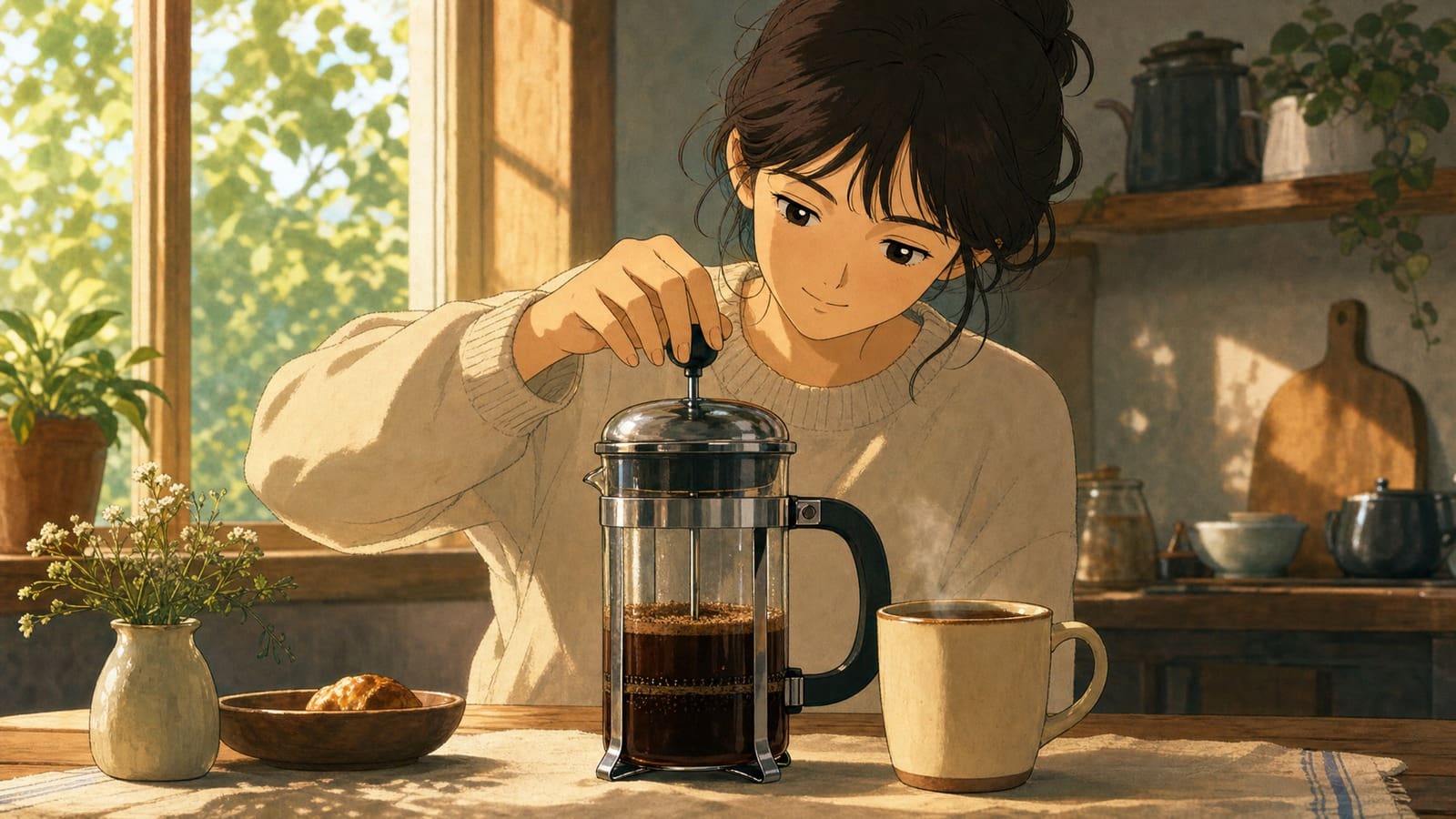
Plunge Speed Is a Variable, Not an Afterthought
Most people plunge fast because they’re impatient. Fast plunging is one of the most reliable ways to force fine particles through the mesh filter and into your cup. The pressure spike from a rapid plunge overwhelms the filter’s ability to trap sediment.
The correct technique: apply slow, steady downward pressure over 20–30 seconds. You should feel resistance throughout the plunge. If the plunger drops with almost no resistance, your grind is too coarse. If it’s nearly impossible to press, it’s too fine. Consistent, moderate resistance is the feedback signal that your grind and filter are working together correctly.
Stop the plunge just before the filter reaches the grounds bed. Pressing all the way to the bottom compresses the grounds and squeezes out bitter, over-extracted liquid from the sediment cake. That last push isn’t adding anything worth keeping.
Particle Dynamics
Drawdown, Sediment, and the Bottom of the Cup
Even a perfect plunge leaves a sediment layer at the bottom of the carafe. French press coffee is not a filtered brew—some fine particles will always make it through the mesh. The question is how many.
Coarser grinds produce larger particles that settle faster and filter more cleanly. Finer grinds increase extraction efficiency but dramatically increase sediment. For clarity-focused brewing, err slightly coarser than you think you need, and compensate with a slightly longer steep or higher temperature rather than a finer grind.
The sediment at the bottom of your cup is also worth respecting. Stop pouring when you see the last inch of liquid turn cloudy—that final pour isn’t adding flavor, it’s adding grit.
The Most Overlooked Variable
Decant Timing: The Step Most Brewers Skip
Here’s the step that separates a good French press from a great one: decant immediately after plunging. The plunger doesn’t stop extraction—it just moves the grounds to the bottom. Coffee sitting above a bed of compressed grounds continues to extract, and it extracts the bitter compounds that emerge late in the process.
If you pour one cup and leave the rest in the carafe for ten minutes, that second cup will taste noticeably more bitter and less sweet than the first. The fix is simple: pour all the brewed coffee into a separate thermal vessel right after plunging. Your last cup will taste as good as your first.
Highest-Leverage Habit
Decant immediately. Every time.
This single habit is the highest-leverage change most French press brewers can make. It costs nothing, takes ten seconds, and eliminates the single most common source of late-cup bitterness. If you do nothing else from this guide, do this.
Common Questions
Frequently Asked Questions
Does bloom matter if my coffee is a few weeks old?
Less so. Older coffee has already off-gassed significantly, so the bloom produces less visible activity. It still helps with even saturation, but the impact on extraction evenness is smaller. Freshly roasted coffee—ideally within two to four weeks of roast date—benefits most from a proper bloom.
Why does my French press taste bitter even with good beans?
The most common culprits are over-extraction (too fine a grind, too long a steep, or water that’s too hot), aggressive agitation that suspends fines, or continued extraction from leaving the coffee on the grounds after plunging. Check decant timing first—it’s the most overlooked variable.
Can I use the same ratio for light and dark roasts?
Start at 1:15 for both, but expect to adjust. Lighter roasts often need slightly higher temperature and longer steeps to fully develop sweetness. Darker roasts extract faster and can become bitter quickly—they often benefit from a slightly cooler brew temperature or a shorter steep window.
What grind size is best for sediment control?
A coarse, even grind—roughly the texture of coarse sea salt—minimizes fines and sediment. Blade grinders produce too many fine particles for clean French press brewing. A burr grinder with consistent particle size is the single biggest equipment upgrade you can make.
Does water quality affect French press clarity?
Yes. Hard water with high mineral content can produce a cloudy, chalky cup independent of sediment. Filtered water in the 150–200 ppm total dissolved solids range is a reliable target for clean, expressive extraction.
Complete Protocol
The Six Habits That Actually Move the Needle
Bloom your coffee
Pour twice the weight of your coffee in hot water, wait 30–45 seconds for CO2 to release, then add the remaining water. Even extraction starts here.
Stir once, gently
A single pass after the full pour ensures even saturation. That’s all you need. More stirring means more sediment—it’s a direct trade-off.
Break the crust slowly
Use two spoons to push the surface crust to the sides rather than stirring it in. Let settled grounds stay settled so they can compact cleanly before the plunge.
Plunge over 20–30 seconds
Slow, steady pressure throughout. Feel the resistance—it tells you your grind and filter are working correctly. Rapid plunging forces fines through the mesh.
Stop before the bottom
Halt the plunge just before the filter contacts the grounds bed. Pressing to the bottom compresses the cake and squeezes bitter liquid into your brew.
Decant immediately
Pour everything into a thermal vessel right after plunging. The plunger doesn’t stop extraction. Coffee left above compressed grounds continues to over-extract.
Final Takeaway
What Actually Matters Most
French press brewing physics isn’t about obsessive precision—it’s about understanding which variables actually move the needle and which ones you can stop worrying about. Bloom your coffee. Stir once. Break the crust gently. Plunge slowly. Stop before the bottom. Decant immediately.
Those six habits, applied consistently, will do more for your cup than any equipment upgrade or exotic bean. The four-minute steep is just the clock. What you do around it is the craft.
