
15 min read
Best Commercial
Coffee Roasters
A practical buying guide for roastery owners, café operators, and specialty coffee entrepreneurs.
3–6 kg range
10–25 kg range
efficiency-focused
Buying a commercial coffee roaster is one of the most consequential equipment decisions a roastery will make. Get it right and you have a machine that shapes your product quality, your production capacity, and your brand for years.
Get it wrong and you’re stuck with a bottleneck — or worse, a machine you’ve outgrown in eighteen months. This guide is built for small roastery owners, café operators, and specialty coffee entrepreneurs who are ready to move beyond home equipment and invest in something built for real production volume.
The best commercial coffee roaster for your operation depends on three things above everything else: your current batch size requirements, your heat source availability (natural gas vs. electric), and how much roasting control you need day to day. Most growing roasteries will land between a 5 kg and 25 kg drum roaster, with gas-fired machines dominating the commercial space. Budget realistically — entry-level commercial starts around $10,000–$20,000, and serious production machines run well beyond that.
In This Guide
7 sections · 8-minute read
What Makes a Roaster Truly Commercial?

The word “commercial” gets stretched in marketing copy. A genuine commercial roasting machine is designed for consistent, repeatable production runs across multiple batches per day — with build quality, airflow systems, and heat management that home or prosumer units simply can’t match.
Drum vs. Fluid Bed Roasters
| Drum Roaster | Fluid Bed (Air) Roaster | |
|---|---|---|
| How it works | Beans tumble in a rotating heated drum | Hot air suspends and roasts beans |
| Industry prevalence | Dominant at commercial scale | Niche — less common commercially |
| Roast control | Wide range of heat application, fine control | Less conductive input, faster roasts |
| Flavor profile | Rich, complex — wide range of profiles | Bright, clean — favors lighter roasts |
| Parts & support | Well-supported globally | Smaller community, fewer technicians |
| Learning curve | Moderate — well-documented | Steeper if switching from drum |
| Best for | Most commercial operations | Roasters with specific profile goals |
For most growing roasteries, a drum machine is the safer starting point. Fluid bed roasters like those from Sivetz and Joper have a real following among roasters who prioritize bright, clean cup profiles — but expect a steeper learning curve and a smaller support network.
Gas vs. Electric
Natural gas dominates commercial coffee roasting for good reasons: gas-fired machines heat up faster, recover between batches more efficiently, and generally offer more precise heat control at high throughput. If your facility has gas access, a gas roaster is almost always the right call.
If Gas Isn’t Available
Electric commercial roasters exist and have improved significantly, but they’re more common in smaller or entry-level commercial machines where throughput demands are lower. Before purchasing any electric commercial roaster, verify that your electrical supply can handle the draw — these machines can pull significant amperage.
Batch Size and Throughput

This is where many buyers miscalculate. Think about where your production needs will be in two to three years, not just today.
Back-to-back batches in real-world conditions. A good start, but it fills quickly if you’re supplying wholesale.
Roughly doubles throughput. A meaningful floor for roasteries with active wholesale accounts.
Serious production volume. Appropriate for established roasteries with multiple wholesale partners.
Undersizing your roaster creates a ceiling on revenue. If you’re supplying wholesale accounts in addition to retail, a machine you’ll outgrow in eighteen months is a costly mistake — both in the capital spent and the downtime required to upgrade mid-season.
Key Features to Evaluate
Not all commercial roasters are built equally. These are the variables that separate a machine you’ll grow with from one that becomes a problem at scale.
For specialty coffee operations focused on quality consistency, roast profiling capability is not optional. Look for machines with built-in profiling software or compatibility with third-party platforms like Cropster or Artisan. This is how you replicate a great batch across hundreds of pounds of green coffee.
Stainless steel construction, robust drum bearings, and high-quality burner assemblies indicate a machine built to run hard. Commercial roasters work in high-heat, high-cycle environments. Cheap materials show up quickly as uneven roasting, inconsistent airflow, or mechanical failures that shut down production.
This is underweighted by most buyers and dramatically overweighted by buyers who’ve had a roaster go down mid-season. Before purchasing, ask directly: what is the lead time on common replacement parts? Is there a technician network in your region? What does the warranty actually cover?
A roaster that’s difficult to operate consistently creates quality variance, especially when staff turns over. Look for clear, intuitive controls, good documentation, and a sight glass or transparent lid that lets operators monitor bean color and development without interrupting the roast.
“Parts availability and responsive customer service are genuine competitive differentiators among commercial roaster manufacturers. Weight them as heavily as features.”
Best for Small Cafes & Micro-Roasteries

For a small cafe or micro-roastery producing under 50 lbs per day, entry-level commercial drum roasters in the 3–6 kg range offer a practical starting point — commercial-grade build quality at a price that doesn’t require a second mortgage.
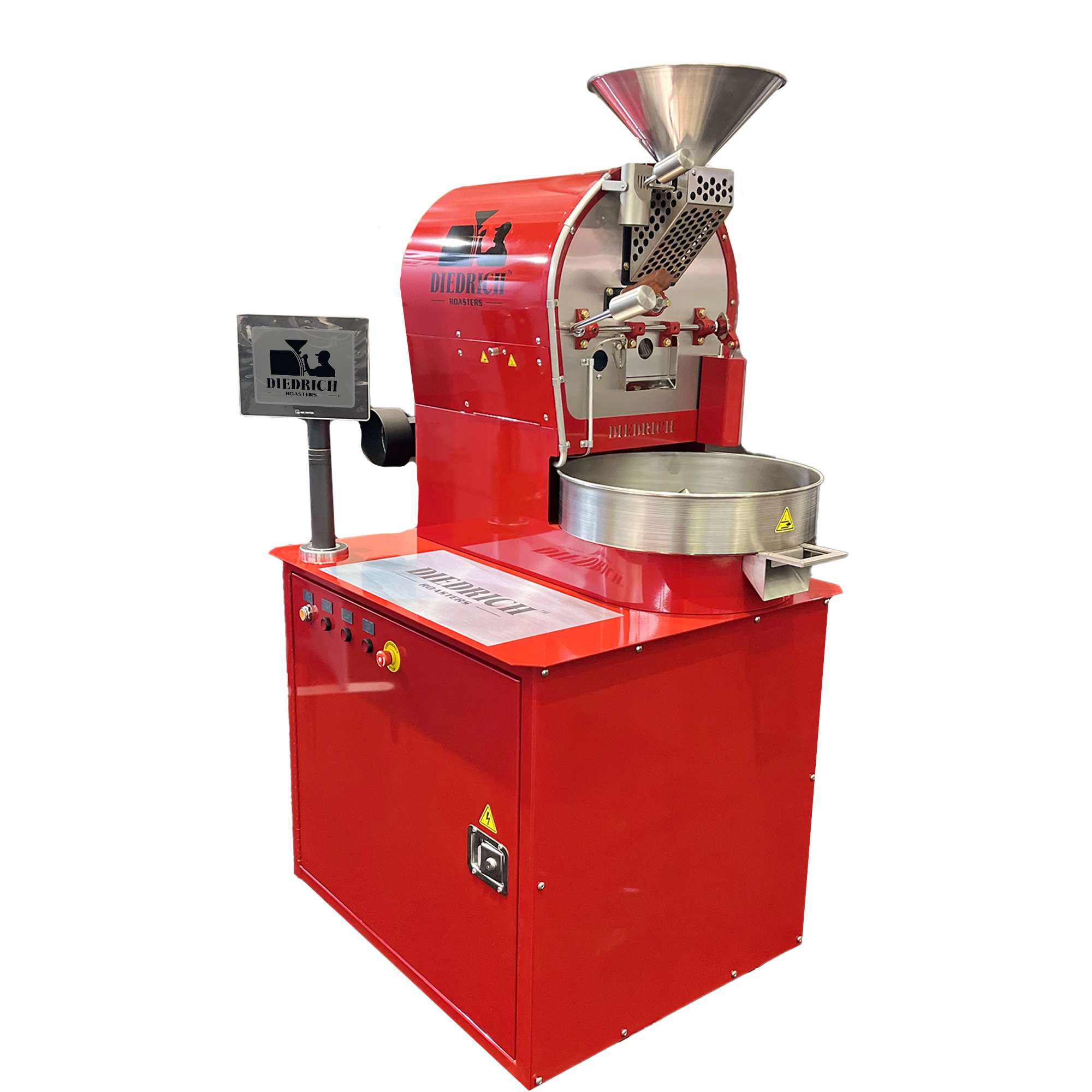
Diedrich DR-3 — Image via diedrichroasters.com
The DR-3 is Diedrich’s entry point into the specialty roaster line — a compact, well-built machine that delivers the same profile control and build philosophy as their larger units at a footprint and price point suited to small-space operations. The infrared burner system allows conductive, convective, and radiant heat application with real control over roast development. Automation is available for operators who want profile replay capability.
For a café that wants to roast in-house without committing to large production volume, the DR-3 is one of the most credible starting points in the category. U.S.-based support and strong parts availability mean downtime is manageable when service is needed.
- Genuine commercial build quality at a compact size
- Cropster and Artisan integration standard
- Strong domestic parts and support network
- Manual, semi-auto, or fully automated versions
- 26 lbs/hr output is modest for growing wholesale volume
- Will require upgrade as production scales significantly
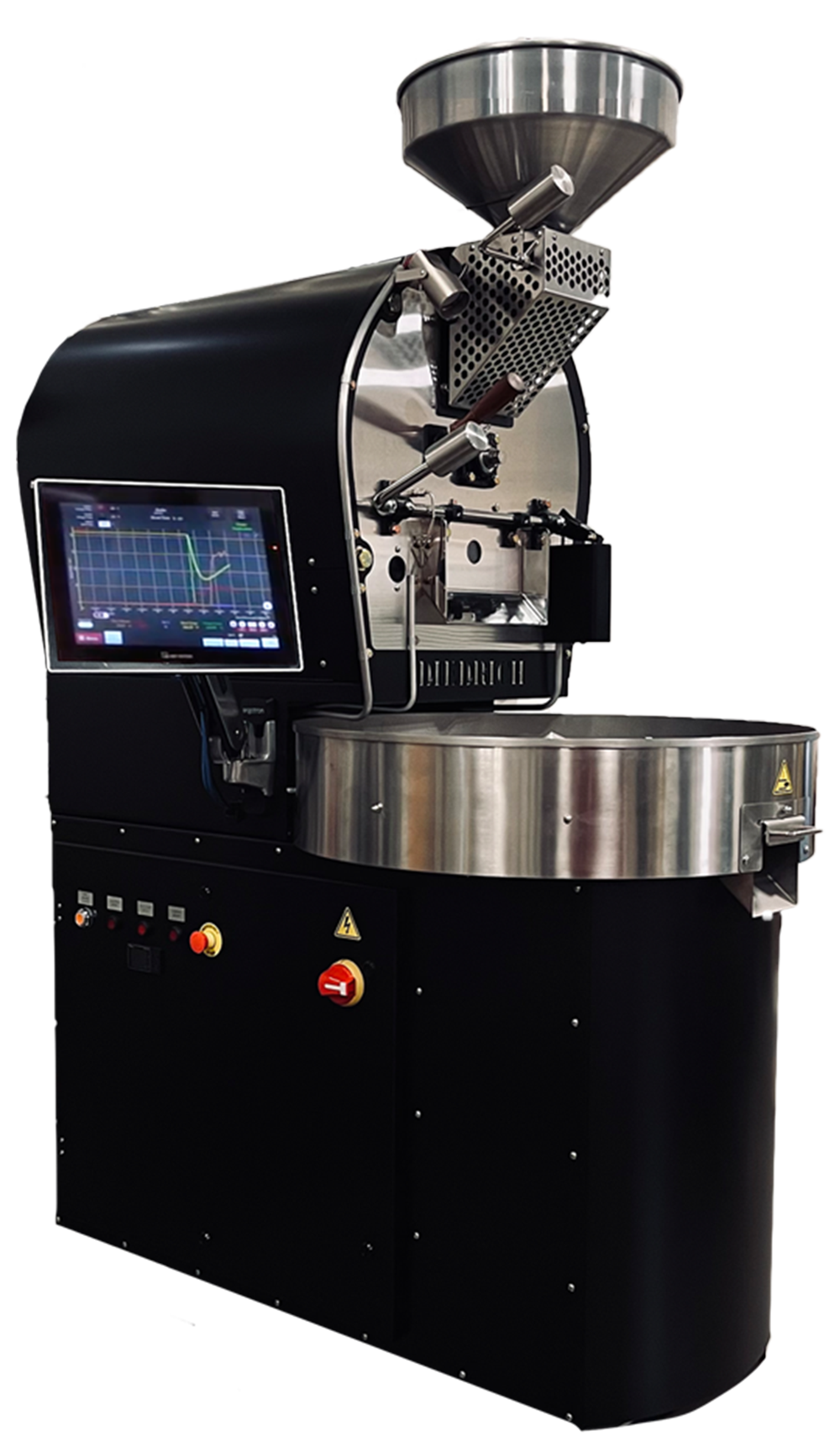
Diedrich DR-5 — Image via diedrichroasters.com
The DR-5 is the step up from the DR-3 and a natural fit for cafés that know they’ll need more throughput within the first year or two of in-house roasting. Variable speed on roast air, cooling air, and drum speed give operators meaningful control over roast development. The external chaff cyclone is a practical upgrade over internal collection for higher-volume roasting.
If you’re deciding between the DR-3 and DR-5, the extra batch capacity of the DR-5 is usually worth the incremental cost for anyone planning to supply even modest wholesale volume alongside retail. It’s the roaster that will outlast your early growth phase where the DR-3 may not.
- Meaningfully more throughput than the DR-3
- External chaff cyclone for cleaner operation
- Improved insulation package vs. earlier models
- Same strong Diedrich support network
- Still a small-batch machine for serious wholesale volume
- Higher capital cost than entry prosumer alternatives
Probat & Mill City — Also Strong in This Range
Probat’s P Series (P05, P12) and Mill City’s MCR-3D and MCR-6 are equally credible options at this scale. Probat brings a 150-year manufacturing pedigree and beautiful build quality. Mill City offers strong U.S.-based education and support resources, competitive pricing, and now domestic fabrication. Both are worth serious consideration alongside Diedrich — the right choice often comes down to regional service availability and personal preference after demoing each machine.
Best for Growing Roasteries Scaling Production
Roasteries moving from boutique to meaningful wholesale volume should be evaluating machines in the 10–25 kg range. These are machines with serious production pedigree, strong parts networks, and the kind of roast control that specialty coffee demands.
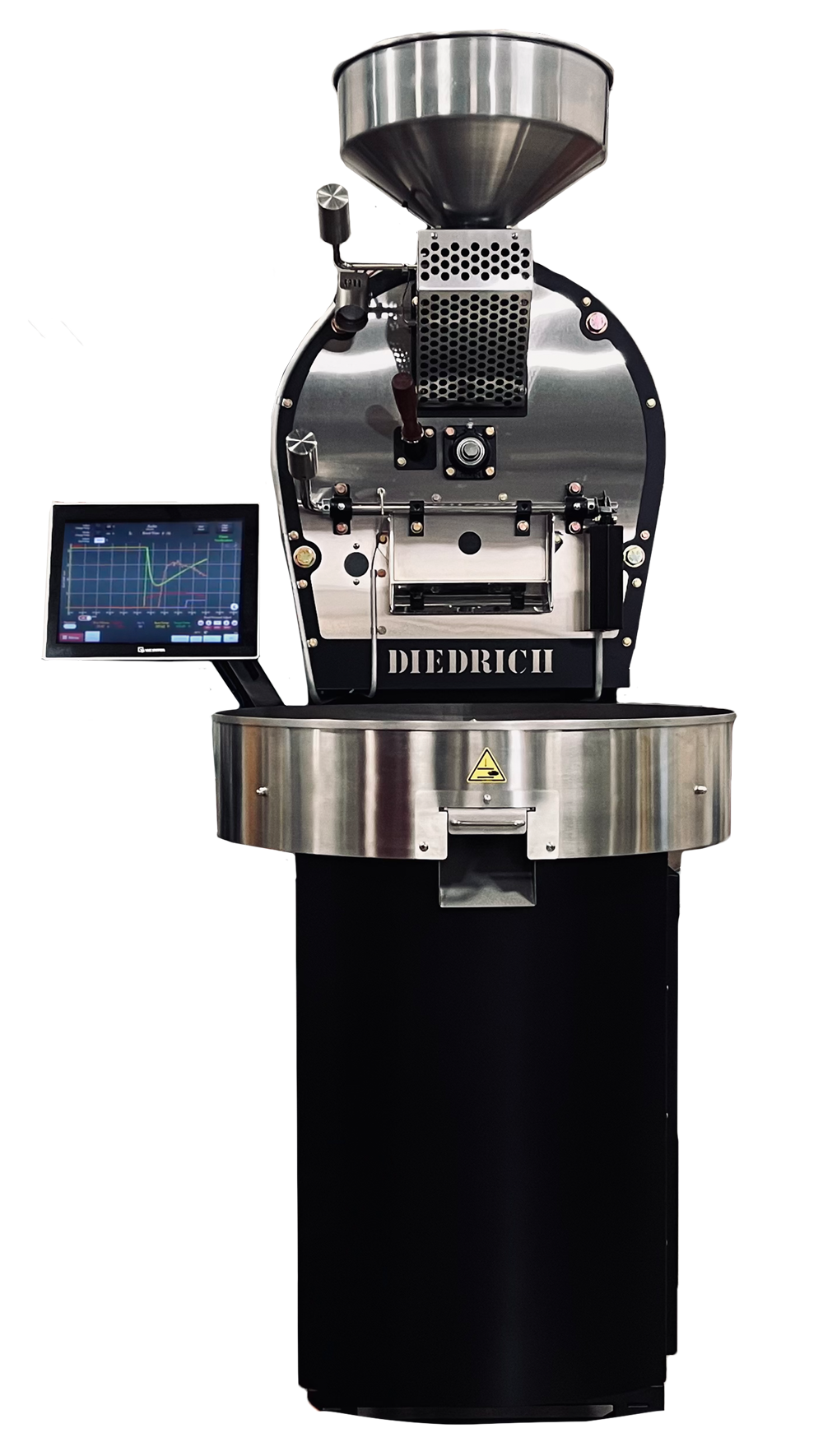
Diedrich DR-12 — Image via diedrichroasters.com
The DR-12 is where Diedrich’s reputation for precision heat management and solid construction becomes truly compelling for a working roastery. At 92 lbs per hour of real-world output, it’s a machine that can sustain meaningful wholesale volume without becoming a daily production bottleneck. The automated control system, direct Cropster and Artisan integration, and half-batch capability give roasters the flexibility to handle varied order sizes without wasting green coffee or losing roast accuracy.
The DR-12 is widely respected in the specialty coffee industry and frequently cited by roasters as a benchmark in its class. If you’re pricing out 10–15 kg machines, the DR-12 deserves to be on that shortlist.
- 92 lbs/hr — real production capacity for wholesale
- Half-batch capability for flexibility
- Best-in-class domestic U.S. support network
- Full automation and profile replay available
- Proven track record in specialty roasteries
- Significant capital investment vs. smaller machines
- Requires proper gas installation and ventilation
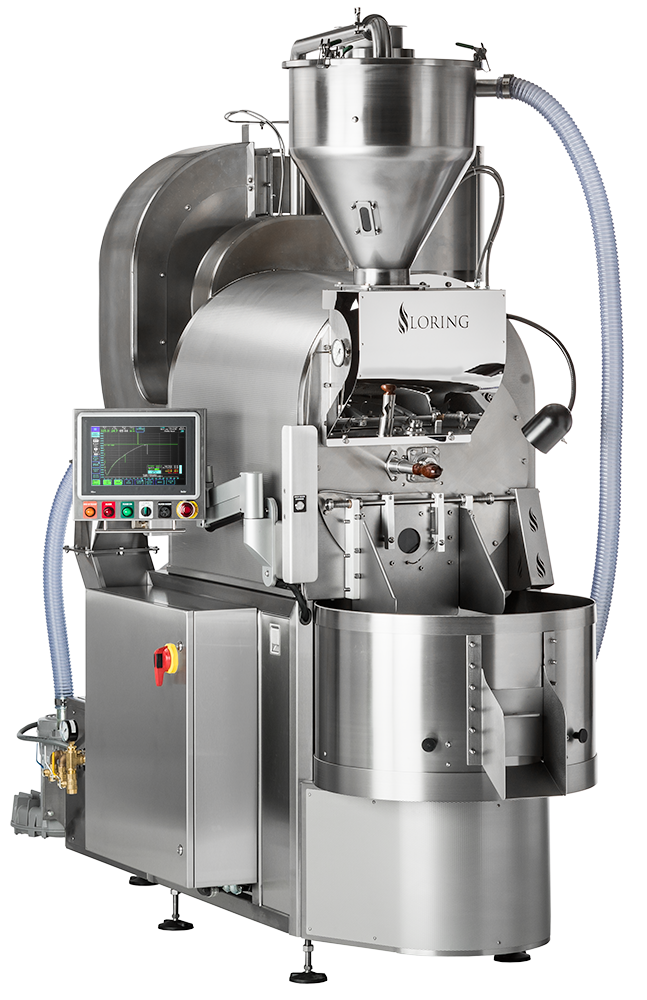
Loring S35 Kestrel — Image via loring.com
The Loring S35 Kestrel represents a genuinely different approach to commercial roasting. Its single-burner, recirculating design uses the same heat source to roast the coffee and incinerate smoke, eliminating the need for a separate afterburner while dramatically reducing gas consumption — up to 80% fuel savings compared to conventional drum roasters in comparable use cases.
The efficiency gains are real and meaningful for roasteries where gas costs or local emissions regulations are significant factors. Smokeless, near-odorless exhaust during roasting opens up installation options that simply aren’t available with traditional drum roasters. The flavor profile it produces — using primarily convective heat rather than a drum-and-conduction mix — tends toward cleaner, brighter cup characteristics with exceptional batch-to-batch consistency.
The price point is significantly higher than comparably sized drum roasters. Loring is an excellent choice for roasteries that have volume to justify the capital investment and want to make gas efficiency or emissions reduction a core part of their operation.
- Smokeless roasting — opens installation options
- Up to 80% fuel reduction vs. traditional drum
- Exceptionally consistent cup profiles
- No external afterburner required
- Designed and made in California
- Significantly higher price than comparable drum roasters
- Roasting behavior differs — requires relearning if switching from drum
- Smaller technician network than Probat or Diedrich
San Franciscan Roaster Company & Used Machines
San Franciscan’s SF-25 (12 kg / 25 lb) is a well-regarded American-made option that comes up frequently in specialty coffee circles — handmade, solid construction, and respected for heat management. The used commercial roaster market is also legitimate and worth exploring: a well-maintained Probat or Diedrich with a documented maintenance history can be an ideal choice for a budget-conscious operation. Have any used roaster inspected by a qualified technician before purchase, and confirm that replacement parts are still available for the model.
Who Should Skip a Commercial Roaster For Now

Not every roasting operation is ready for commercial infrastructure. Getting the timing right is just as important as getting the machine right.
⚠ Two Signs You’re Not Ready Yet
If you’re roasting fewer than 20–30 lbs per week consistently, a commercial machine is likely more infrastructure than your current volume justifies. And if you haven’t yet established a reliable supply chain for green coffee or a consistent customer base, wait. The roaster is not the bottleneck at that stage — demand is.
The economics of commercial roasting require real production volume to pencil out. The capital cost, facility requirements (gas line, ventilation, floor load ratings, fire inspection), and operating overhead of a commercial roaster all assume you’re filling the machine regularly. At very low throughput, a high-quality prosumer machine while you build your customer base is a smarter bridge.
- Roasting 30+ lbs per week consistently
- Supplying at least two or three wholesale accounts
- Facility has gas access and proper ventilation
- Production is your current bottleneck, not demand
- You’ve identified service and parts support in your region
- Under 20 lbs per week roasted
- No established wholesale customer pipeline yet
- Facility modifications would be needed before installation
- Demand is uncertain — supply chain not yet stable
- Capital is better deployed on green coffee sourcing and marketing
Frequently Asked Questions
What is the best commercial coffee roaster for a small café?▼
For most small cafes, a gas-fired drum roaster in the 3–6 kg range from a manufacturer like Diedrich, Mill City, or Probat is the practical starting point. It offers commercial-grade build quality and roast control without the capital cost of a large-scale production machine. The Diedrich DR-3 and DR-5 are strong specific options; Probat’s P Series and Mill City’s MCR-3D and MCR-6 are equally credible depending on your region and service priorities.
How much does a commercial coffee roaster cost?▼
Entry-level commercial roasters typically start between $10,000 and $20,000. Mid-range production machines in the 10–25 kg range run from $25,000 to $60,000 or more — the Diedrich DR-12 and Mill City MCR-20 land in this range. Premium machines like Loring Smart Roast systems can exceed $100,000. Used equipment can significantly reduce upfront cost if purchased carefully from a reputable source with documented maintenance records.
What is the difference between a drum roaster and a fluid bed roaster?▼
Drum roasters use a rotating drum to tumble beans through heat — conductive, convective, and (on infrared designs) radiant. They’re the industry standard at commercial scale, well-supported globally, and capable of a wide range of roast profiles. Fluid bed roasters suspend beans in a column of hot air, roasting faster with a different flavor profile that tends toward brightness and clarity. They’re less common at true commercial scale and carry a steeper learning curve for roasters switching from drum equipment.
Is natural gas necessary for a commercial coffee roaster?▼
Not strictly necessary, but strongly preferred. Gas-fired machines heat faster, recover between batches more efficiently, and dominate the commercial market because of those advantages. Electric commercial roasters exist and have improved — Diedrich, Probat, and Mill City all offer electric versions — but they’re more common at smaller batch sizes. Verify your facility’s gas access and electrical capacity before committing to either heat source.
What batch size do I need for a commercial roastery?▼
Think about your production needs two to three years out, not just today. A 5 kg roaster running back-to-back batches produces roughly 40 lbs per hour in real conditions. A 12 kg machine roughly doubles that. If you’re supplying wholesale accounts in addition to retail, a 10–15 kg machine is a more realistic floor for sustainable production volume without becoming your own bottleneck.
Should I buy a new or used commercial coffee roaster?▼
Both are legitimate options. A used machine from a reputable manufacturer with a documented maintenance history can be an excellent value — a used Probat or Diedrich in good condition is often a better starting point than a lower-quality new machine at the same price. Have any used roaster inspected by a qualified technician before purchase, and confirm that replacement parts are still available for the model. Avoid anything where the seller can’t explain clearly why it’s being sold.
Match the Machine to the Stage of Your Business
The best commercial coffee roaster is the one that fits your current throughput, your growth trajectory, and your facility — not the one with the most impressive spec sheet. For most small cafes and emerging roasteries, a gas-fired drum roaster in the 5–12 kg range from a reputable manufacturer with strong parts support is the right starting point.
In that range, Diedrich (DR-5 and DR-12) earns its reputation: solid construction, precise heat control, and domestic U.S. support that matters when a roaster goes down mid-week. Probat and Mill City belong on the same evaluation list depending on your region and priorities. As volume grows, the Loring S35 Kestrel becomes worth the premium for roasteries where fuel efficiency and smokeless installation are meaningful factors.
Do the production math before you buy. Talk to roasters who own the machine you’re considering. And weight customer service and parts availability as heavily as features — because eventually, every commercial roaster needs service, and the quality of that support is what separates a manageable interruption from a production crisis.
