
7 min read
☕ Coffee Recipes Hub · Cocktail Science
The Physics
of Espresso
Martini Foam
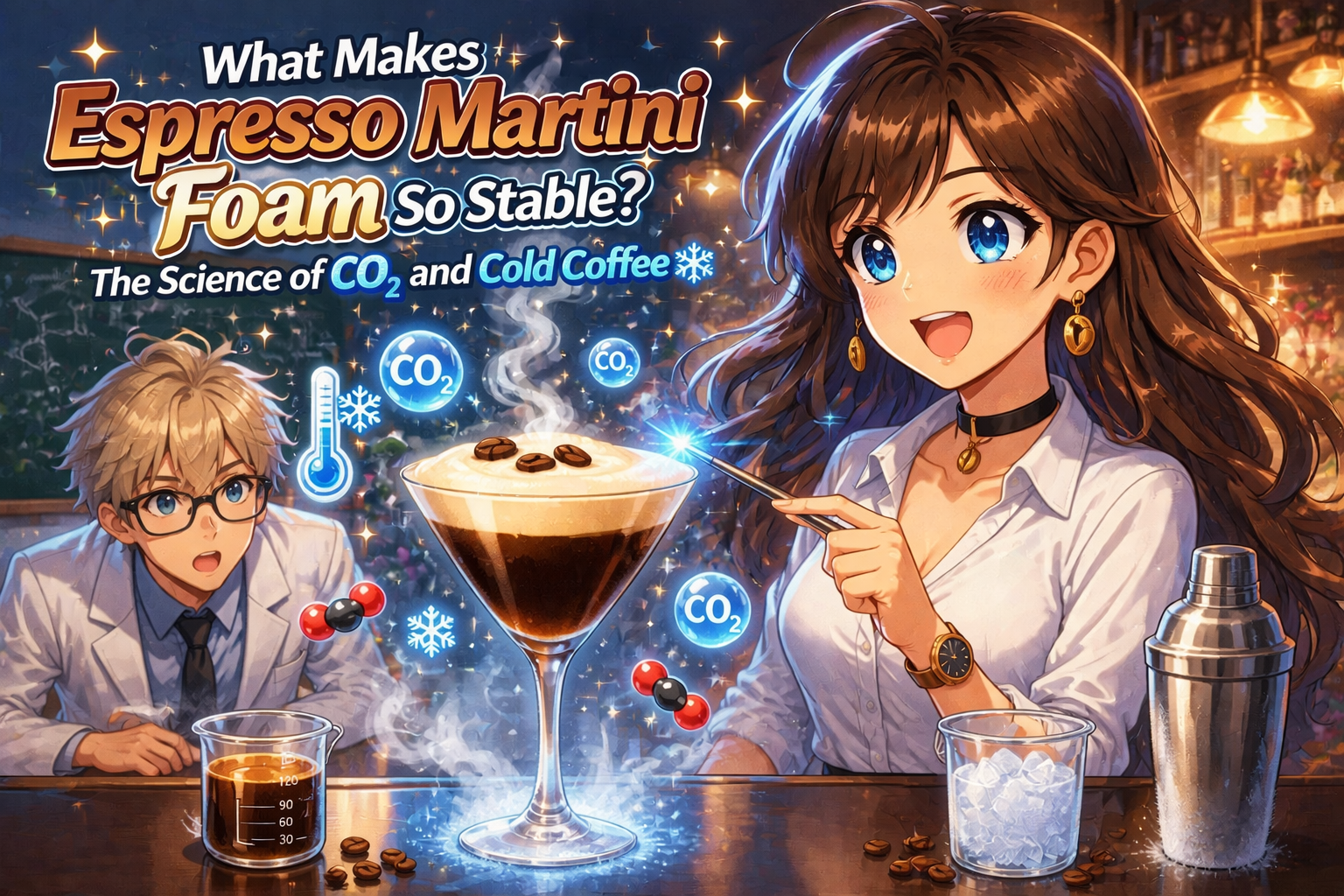
Why CO₂ + Cold = Stability — and why your arms are not the problem.
Gas Pressure · Lipid Viscosity · Kinetic Force
Control them, and the foam is inevitable.
The answer isn’t in your technique. It isn’t in your equipment. It is entirely a matter of physics and chemistry — specifically, the behavior of lipids (coffee oils) and proteins under thermal stress, and the availability of carbon dioxide as a surfactant.
Once you understand what is actually happening inside that shaker tin, the fix becomes obvious. And once you apply the fix, you will never pour a flat Espresso Martini again.
Start treating it like a colloidal dispersion experiment.
Use This With the Main Recipe
This page explains why the foam works. For the classic ratios, shaking sequence, and full build, start with the master espresso martini recipe. If you are still deciding which bottle to buy, see best vodka for an espresso martini.
This guide breaks down each of the four physical variables that determine whether your foam is velvet-thick and persistent or dissipated and gone before the glass reaches the table. Each section ends with a single, actionable fix.
Variable 01
The Invisible Ingredient:
Carbon Dioxide
Most people assume the foam on an Espresso Martini works like the foam on a Whiskey Sour — egg white proteins — or a cappuccino — milk proteins. This is a fundamental misunderstanding of the medium.
Espresso foam is closer to the head on a beer. It is comprised of carbon dioxide (CO₂) bubbles trapped within a lattice of coffee oils and melanoidins. During high-pressure extraction (9 bars), CO₂ stored in the bean’s cellular structure is forced out and creates the crema — that golden-brown microfoam layer on top of your shot.
Here is the critical constraint: CO₂ is a finite resource. It begins depleting the moment the coffee is roasted. If your beans were roasted six weeks ago, that gas has long equalized with the atmosphere. There is no physical mechanism available to generate foam from those beans — the structural component simply doesn’t exist anymore.
Roast Date is a Controlled Variable
Beans are viable for foam generation for approximately 14 days after roasting. After that, internal CO₂ pressure drops below the threshold needed for bubble formation. A roast date is not marketing — it is a structural specification.
Grind Affects Gas Retention Rate
Finer grinds dramatically increase surface area, which accelerates CO₂ off-gassing during extraction. A coarser grind retains more gas longer, releasing it in a slower, more controlled bloom that produces better crema.
Storage Cannot Restore Lost Gas
Freezing stale beans, vacuum-sealing, or any other storage method will not replenish CO₂ that has already dissipated. Storage preserves; it does not regenerate. Fresh beans are the only solution.
The Fix
Treat roast date as a non-negotiable specification. Beans roasted 7–14 days ago are optimal. Source from a local roaster or a direct-ship roastery that prints roast dates. Anything older, and you are building on a foundation that doesn’t exist.
Variable 02
The Thermal Shock
Mechanism
Coffee contains oils. In a hot espresso shot at 93°C (200°F), these lipids are fluid, low-viscosity, and highly mobile. When you shake an Espresso Martini, you are attempting to create an emulsion — you want those oils to coat the air bubbles being whipped into the liquid.
The problem is that lipids behave radically differently depending on temperature. If you take a near-boiling shot and dump it directly onto ice, you create a violent thermal environment: the ice melts instantly (diluting the drink with water before foam can form), and the lipids are shock-cooled unevenly. Instead of forming a smooth, cohesive film around air bubbles, they clump and “shatter” microscopically. The result is foam that looks soapy and coarse rather than velvet and tight.
The Fix — Tempering
After pulling your shot, wait 60 seconds before adding ice. You want the temperature to drop from “near boiling” to “warm” — roughly 55–65°C. This allows the molecular structure of the oils to stabilize. When the ice is eventually added, the transition is far less violent, allowing the lipids to viscosify naturally and trap air bubbles in a stable, cohesive lattice.
This single step — sixty seconds of patience — consistently produces a thicker, more persistent foam. It costs nothing. It requires no equipment. And almost nobody does it.
Variable 03
Viscosity as Structure:
The Role of Sugar
“I don’t like sweet drinks. I’ll skip the simple syrup.”
And just like that, you have destroyed your foam stability. In a cocktail, sugar is not just a flavorant — it is a structural agent. Sucrose increases the viscosity (thickness) of the liquid phase. Imagine the difference between shaking a jar of water and shaking a jar of maple syrup. The syrup holds bubbles; the water does not.
Foam collapse is caused by a process called liquid drainage: gravity pulls liquid down from between the bubble walls, thinning them until they rupture. By adding a sucrose-dense syrup, you slow that drainage by increasing the viscosity of the liquid phase — effectively acting as mortar between the bricks of your bubble lattice.
The Fix
Use Rich Simple Syrup at a 2:1 ratio (sugar:water) instead of the standard 1:1. You get double the viscosity boost with less dilution. The result is foam that can hold a garnish for ten minutes or more — and a drink that reads as barely sweet, because the structural sugar is doing structural work, not flavor work.
Variable 04
Fluid Dynamics:
The Piston Shake
Watch a professional bartender shake a tin. Now watch a home enthusiast. The difference is almost always in the vector of force. Most people “rock” the shaker back and forth — sliding the ice through the liquid. This chills and dilutes, but it does not create cavitation.
To build foam, you need violence. You need to slam the ice from one end of the tin to the other with enough force that the liquid is literally torn apart, creating vacuum cavities that instantly fill with air. This is what produces micro-foam — those microscopic bubbles that give the drink its velvety mouthfeel and meringue-like density.
Swish Method
Ice slides through liquid. Drink chills. Some dilution. No cavitation. Air bubbles are large, unstable, and pop within 60 seconds.
swish · swish · swishThwack Method
Ice slams end to end. Liquid is violently disrupted. Cavitation creates micro-bubbles. Foam is dense, persistent, and structural.
thwack · thwack · thwackThe Fix — Piston Technique
Hold the shaker horizontally. Snap your wrists to throw the ice from the bottom of the tin to the cap in sharp, rhythmic strokes. You should hear a percussive thwack, not a slushy swish. You are using the ice as internal pistons to beat air into the liquid. Twelve to fifteen sharp strokes is usually sufficient; more is not necessarily better once the thermal target is reached.
There is one more variable most guides omit entirely: glassware temperature.
If you pour a −2°C cocktail into a room-temperature glass (+22°C), the thermal energy from the glass immediately transfers to the liquid at the contact point. This warms the lipids, drops their viscosity, and causes the bubble walls at the rim to rupture — producing the infuriating “melting ring” effect where foam disappears from the outside inward.
The Fix — The Freezer Coupe
Store your glassware in the freezer. Always. Pouring a cold liquid into a cold vessel eliminates the thermal gradient entirely. The lipids stay cold, viscosity stays high, and the foam stays structural from rim to finish.
Gas Pressure
Fresh beans
7–14 days post-roast
Lipid Viscosity
Temper 60 sec
Freeze the glass
Kinetic Force
Horizontal piston
Thwack, not swish
Control the Variables.
The Foam is Inevitable.
The difference between a flat, oily Espresso Martini and a café-quality one is rarely the recipe. It is the respect for the physical properties of the ingredients. Ignore the physics, and no amount of arm strength will save you. Understand it, and every pour becomes repeatable.
