
8 min read
🧂 Coffee Recipes Hub · Flavor Science
Sea Salt
in Coffee
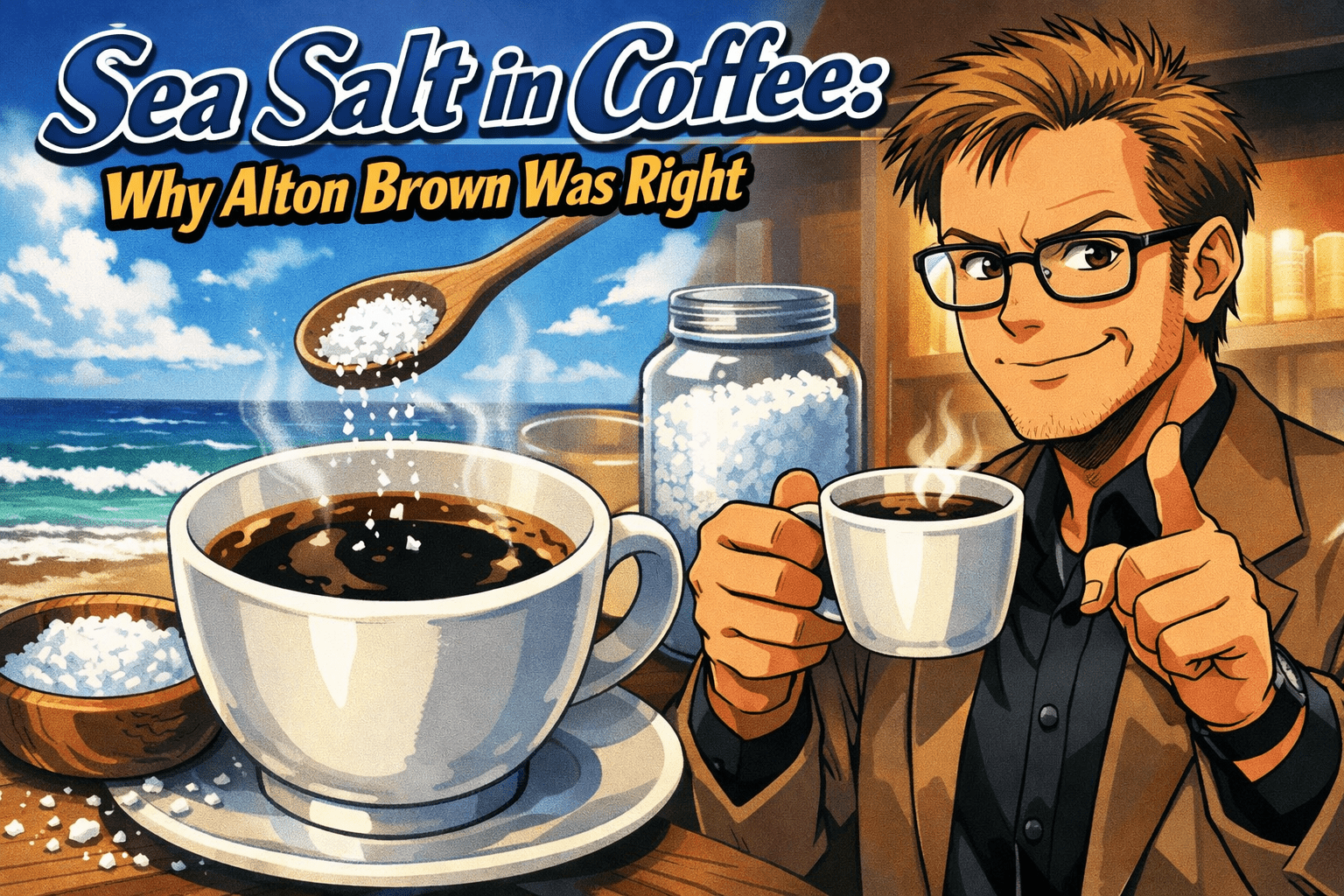
Salt blocks bitter receptors. It makes bad coffee drinkable and good coffee exceptional. Alton Brown figured this out years ago — here’s the science behind why he was right.
Salt doesn’t make coffee taste salty. It makes coffee taste less bitter — and that’s a completely different thing.
When Alton Brown — food scientist, cookbook author, and one of the most rigorously evidence-based voices in American cooking — suggested adding a pinch of salt to coffee grounds before brewing, the internet did what the internet does: it mocked him. The clip circulated as a curiosity, a quirky food-TV moment, a piece of advice that sounded like it belonged alongside putting mayonnaise on steak.
The problem with that reaction is that Alton Brown was correct. Not in a “well, if you like that sort of thing” way — but in a demonstrably, neurochemically, peer-reviewed way. Sodium ions suppress bitterness perception through a mechanism that operates at the level of your taste receptor cells, independently of flavor or seasoning. It doesn’t add a flavor. It removes one.
The implications for coffee are significant. A pinch of sea salt can rescue stale, over-extracted, or low-quality coffee. It can make a vending machine cup drinkable. It can take an already good pour-over and reveal sweetness that no amount of brewing adjustment will replicate. And it costs essentially nothing.
Section 01
Why It Works:
Receptor-Level Science
To understand why salt works in coffee, you need to understand how bitterness is perceived. Bitterness isn’t simply a flavor — it’s a biological warning system. The human body evolved to treat bitter compounds as potentially toxic, which is why we’re exquisitely sensitive to them even at extremely low concentrations.
Coffee contains hundreds of bitter compounds, including caffeine, chlorogenic acids, and melanoidins produced during roasting. When these molecules bind to bitter taste receptors (TAS2Rs) on your tongue, they trigger the perception of bitterness. The more binding, the more bitterness.
🔬 The Alton Brown Mechanism
How Sodium Ions Suppress Bitterness
Sodium ions (Na⁺) from dissolved salt interact directly with bitter taste receptor cells through ion channel modulation. Sodium reduces the sensitivity of TAS2R receptors by competing with bitter compounds for active sites and by altering the ion concentration gradient across the taste cell membrane — effectively raising the threshold required for a bitter signal to fire. The result: the same concentration of bitter compound produces a weaker bitterness signal. You haven’t removed the bitterness chemically. You’ve turned down the volume on the receiver.
Bitterness Suppression
Sodium ions raise the activation threshold for bitter taste receptors, meaning the same concentration of bitter compounds registers as less bitter. This is well-documented in taste physiology research going back decades.
Sweetness Enhancement
When bitterness is suppressed, the natural sweetness notes in coffee — from sugars produced during roasting — are no longer masked. The coffee doesn’t become sweet; it reveals sweetness that was always there.
Acidity Smoothed
Salt also mildly suppresses sour perception at low concentrations, softening harsh acidity in over-extracted or low-quality brews while leaving the desirable bright acidity of good coffee largely intact.
The Stale Coffee Fix
Old beans lose their aromatics but retain their bitter compounds — which is why stale coffee tastes flat but harsh. Salt is uniquely effective here: it addresses the bitterness without needing aromatics to compensate.
This is why the effect is most dramatic on dark roasts and stale coffee — those have the highest bitter compound concentration. On a lightly roasted single-origin, the effect is subtler but still present: a gentle rounding, a slight lift of the fruit and floral notes that were being crowded out.
Section 02
The Method:
Getting the Amount Right
The technique couldn’t be simpler. The only variable that requires attention is quantity — because salt in coffee operates within a very specific range. Too little and you won’t notice anything. Too much and you will absolutely notice it, in all the wrong ways.
The Golden Rule
You should never be able to taste the salt. If the coffee tastes even faintly salty, you’ve used too much. The target dose is below your sensory detection threshold for saltiness — present enough to modulate receptor function, invisible enough that it reads as “smoother coffee,” not “salty coffee.”
Sea Salt Coffee
2 ingredients · Zero technique required
-
1
Brew your coffee — any method, any roast
This works with everything: drip, French press, espresso, pour-over, Moka pot, even instant. The effect is most pronounced on dark roasts, commodity-grade coffee, or anything that’s been sitting in the bag for more than a month. Light roasts and high-quality specialty coffee will show a subtler effect — still noticeable, but more of a polish than a rescue.
-
2
Add a tiny pinch of sea salt
The target quantity for a standard 8–12oz cup is roughly ⅛ teaspoon — which looks like almost nothing. Pinch a small amount between your fingers and tap it over the cup. Alternatively, add it directly to your coffee grounds before brewing, which distributes it more evenly through the extraction. This is Alton Brown’s preferred method and tends to produce a slightly more integrated, seamless result.
-
3
Stir briefly and taste
Give the cup a quick stir to dissolve the salt fully, then taste. You should notice the bitterness has receded and the coffee tastes rounder, slightly sweeter, and more full-bodied — without any perceptible saltiness. If you can taste salt, the amount was too generous. Start again with less; the effective dose is consistently lower than intuition suggests.
Which salt you use matters more than you’d expect:
Fine Sea Salt
✓ Best ChoiceDissolves instantly, pure sodium chloride, no mineral interference. Clean and precise.
Kosher Salt
~ GoodWorks well but dissolves more slowly. Use slightly less by volume due to coarser grain size.
Iodized Table Salt
✗ Skip ItPotassium iodide can add a faint medicinal note. Use pure sea salt for clean results.
Section 03
From Behind the Bar:
The Thing Nobody Admits
The technique has a long history outside of specialty coffee circles. Turkish coffee has traditionally been made with a pinch of salt in some regional preparations. Certain Scandinavian brewing traditions call for salted grounds. The practice exists across enough independent culinary traditions that it almost certainly predates any formal understanding of the neurochemistry behind it — people discovered empirically that it worked.
What Alton Brown did was apply the language of food science to an old folk practice and make it legible to a mainstream audience. The mockery he received says more about our cultural suspicion of counterintuitive food advice than it does about the validity of the technique.
Try it once on a cup you were going to throw out anyway. The evidence will arrive in the first sip.
Section 04
What Changes:
A Flavor Breakdown
Here’s an honest account of exactly what salt does and doesn’t change in a cup of coffee:
| Flavor Dimension | Effect of Salt | Magnitude |
|---|---|---|
| Bitterness | Significantly suppressed — the most dramatic and reliable change | Strong |
| Perceived Sweetness | Noticeably enhanced as bitterness recedes and natural sugars emerge | Strong |
| Body / Mouthfeel | Slightly fuller and rounder — salt enhances perception of viscosity | Moderate |
| Acidity | Mildly softened — harsh sourness reduced, bright acidity largely preserved | Moderate |
| Aroma | Unchanged — salt has no effect on volatile aromatic compounds | None |
| Saltiness | Should be completely imperceptible at the correct dose | None |
| Overall Balance | Dramatically improved, especially on dark roasts and lower-quality beans | Strong |
The net result is a cup that tastes like a better version of itself — not different, not seasoned, just smoother, sweeter, and more coherent. It’s the rare kitchen trick that works exactly as advertised, every time, on the first try.
Alton Brown Was Right.
The science is real, the technique is free, and the improvement is immediate. There is genuinely no downside to trying this.
Salt in coffee is the most accessible, best-evidenced, and least-appreciated flavor hack in the kitchen. It requires nothing you don’t already own, adds no calories, costs fractions of a cent per cup, and demonstrably improves the drinking experience across every category of coffee. The only surprising thing about it is that it took a television food scientist to make the general public take it seriously. Give it a try — preferably on the worst cup of coffee you can find. The contrast will be instructive.
