
12 min read
Coffee History · Equipment
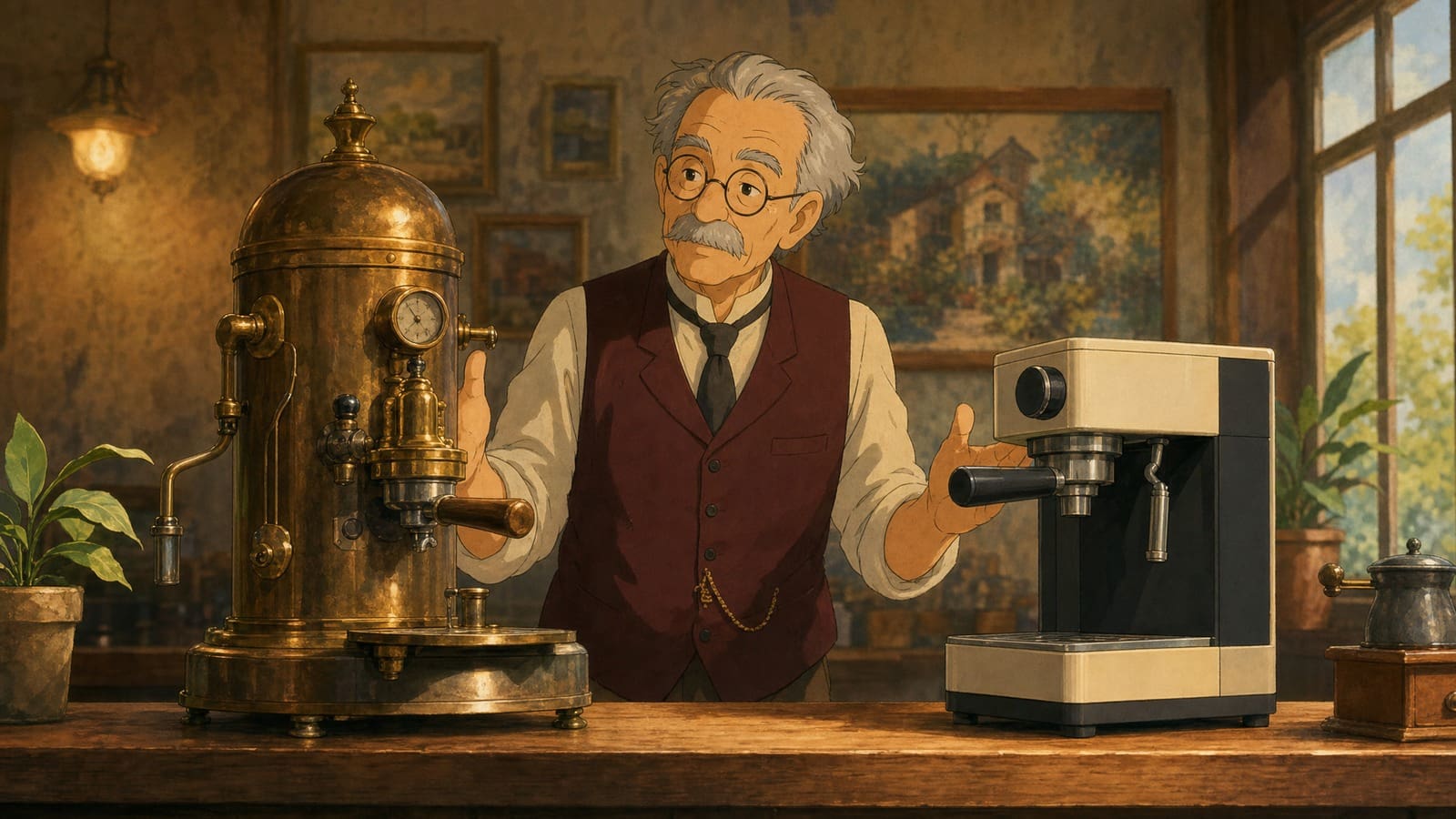
From Steam to
Sustainability
a deep dive into the history of espresso machines
Brass boilers, ticking levers, hissing groups, and the slow march toward the cup of espresso you pull at home today.
Every espresso shot you pull is the end of a 140-year argument about pressure, heat, and what coffee can be when you stop letting it drip and start forcing it.
Espresso didn’t arrive fully formed. It was hammered out in workshops in Turin and Milan, refined by competing inventors who borrowed from steam engines and bicycle pumps, and slowly tamed into something that could sit on a counter and brew a 25-second shot on demand. The machines that did the taming are the real story.
This is a guide to where espresso machines came from, what they actually changed, the recent research that’s rewriting parts of the standard timeline, and where the technology is heading next.
The first commercial espresso machine was patented by Angelo Moriondo in Turin in 1884, but the version that defined modern espresso came from Luigi Bezzera in 1901, was commercialized by Desiderio Pavoni in 1905, and was transformed by Achille Gaggia’s 1948 lever — the first design to produce real crema. Everything since is iteration.

Chapter One
The Steam-Powered Origins
Before the espresso shot existed, Italian cafes brewed coffee the slow way: percolators, moka pots at home, and infusion methods borrowed from the rest of Europe. The problem was speed. A busy bar in Naples or Milan needed a way to serve coffee in seconds, not minutes, without sacrificing flavor.
The fix turned out to be pressure. If you could push hot water through finely ground coffee fast enough, you could pull a concentrated cup in under a minute. Doing that reliably, at scale, took three inventors working over twenty years.
Angelo Moriondo
Patented the first “new steam machinery for the economic and instantaneous confection of coffee beverage” at the Turin General Expo. Bulk brewer, not single shots — but the pressure idea was his.
Luigi Bezzera
Filed the patent that defined modern espresso: single-cup brewing, group heads, portafilters. His “Tipo Gigante” was loud, dangerous, and brewed coffee in roughly 45 seconds.
Desiderio Pavoni
Bought the Bezzera patent, refined the design, added a pressure-release valve so baristas didn’t get scalded, and built La Pavoni into the brand that put espresso on every Italian counter.
Why pressure mattered
Steam-only machines hit around 1.5 to 2 bars of pressure — enough to extract coffee fast, but not enough to produce the dense, syrupy shot we associate with espresso today. Early steam-pulled coffee was bitter, thin, and inconsistent. The water also tended to be too hot, scorching the grounds.
For roughly the first half-century of espresso, this was just “how the drink tasted.” Customers loved the speed and the social ritual. Nobody had tasted anything better, because nothing better existed yet.
Get the 21-Day Coffee Glow-Up Recipe Book
Make your morning coffee feel like a treat again: 21 coffee-shop-style recipes you can make at home, with hot, iced, creamy, cozy, and Java Burn-friendly options.
- 21 craveable coffee recipes
- Simple flavor formulas and shopping list
- 7-day coffee glow-up plan
You are in. Grab the recipe book, then check your inbox to confirm the coffee newsletter.
Download the free recipe bookAlready subscribed? Open the recipe book here.
Why readers save it: It gives them recipes first, not hype first. Java Burn stays optional and label-directed, while the download gives them a better coffee routine they can use right away.
What happens next: MailPoet adds them to the Golden Lamb Coffee Newsletter, sends the welcome email, and includes them in the weekly coffee tips nurture sequence.
Educational download. Not medical advice. Java Burn is a dietary supplement; read the label and ask a qualified professional if you use supplements, take medication, or manage a health condition.
Chapter Two
Benefits and Risks
It’s easy to read the history of espresso machines as a clean march of progress. It wasn’t. Every gain came with a tradeoff — some practical, some cultural, some literally explosive.
What the machine gave coffee
- Speed. A drink that took minutes to brew now took thirty seconds. Cafe service became viable at scale.
- Consistency. Pressure and temperature were finally measurable variables. Two shots in a row could actually taste alike.
- A new beverage category. Cappuccino, macchiato, latte — none of them exist without a machine that can pull a real shot and steam milk.
- Cafe culture. The bar-counter ritual, the standing espresso, the post-meal demitasse — all built around the machine’s footprint.
What it cost
- Real safety risk. Early boilers operated near their pressure limits. Burst seals and steam burns were common in the first decades.
- Energy use. Keeping a brass boiler at temperature all day burned a lot of fuel. Efficiency wasn’t a design priority for fifty years.
- Loss of slow methods. Pour-over, infusion, and home brewing got pushed aside in espresso-dominant markets. Some traditions never came back.
- Standardization pressure. Once the machine defined the drink, coffee that didn’t fit its parameters became harder to sell.
The honest read: espresso machines made coffee faster and more consistent at the cost of variety, energy, and occasionally an operator’s eyebrows. The tradeoffs were worth it for the customer, but they reshaped the supply chain and the bean varieties roasters chose to grow.

Chapter Three
Recent Discoveries
The standard story — Bezzera, Pavoni, Gaggia, the lever — is mostly right, but it’s missing chapters. The last decade of coffee research has filled in some of them.
Materials science rewrote what was possible
The shift from brass to chrome-lined boilers in the 1960s, then to multi-boiler stainless steel systems in the 2000s, did more for shot quality than any patent. Temperature stability is a materials problem, not a recipe problem.
Forgotten inventors are back in the record
Pier Teresio Arduino, Eugenio Faema, Carlo Ernesto Valente — figures who refined group head design, pump systems, and heat exchangers but got squeezed out of popular accounts. Their patents are being reread and credited.
Extraction is finally measurable
Total dissolved solids meters, refractometers, and pressure profiling have turned “a good shot” from intuition into data. The same coffee at 9 bars vs 6 bars is essentially two different drinks.
Third wave reframed the machine
Specialty cafes treat the espresso machine as a tool that should disappear behind the bean. Pressure profiling, flow control, and lower extraction temperatures all serve light roasts and single origins instead of dark Italian blends.
Chapter Four
From Lever to Smart Machine
Five real inflection points in espresso machine design. Each one solved a specific problem the previous generation couldn’t.
The Gaggia lever and the birth of crema
Achille Gaggia’s spring-lever group hit 8–10 bars instead of 1.5. The shot came out shorter, denser, and topped with a golden foam nobody had seen before. Customers asked what the “cream” on top was. Gaggia called it crema and sold it as a feature.
Piston-driven control
Manual lever machines forced the barista’s arm to be the variable. Hydraulic and pneumatic pistons standardized the pressure curve, made cafes less reliant on a single trained operator, and quietly killed the lever’s dominance.
The electric pump (Faema E61)
Faema’s E61 introduced a motorized rotary pump that ran water through a heat exchanger before it hit the group. Reliable 9 bars, stable temperature, no more wrestling a spring. The E61 group head is still in production.
Super-automatic machines
Grind, dose, tamp, brew, and dump the puck — all from a single button. Consistency went up, ceiling went down. Office and casual home users got a reliable shot. Specialty baristas mostly didn’t.
Pressure profiling and smart control
Machines like the La Marzocco GS3, Decent DE1, and Slayer let you script pressure across the shot — pre-infusion at 2 bars, ramp to 9, taper out. Phone apps store recipes per bean. The shot is now a programmable curve, not a single number.
Chapter Five
Sustainability and the Future
For most of espresso’s history, the machine was an energy sink that nobody questioned. A 3-group cafe boiler running 14 hours a day uses roughly as much electricity as a small apartment. That math finally caught up.
Energy efficiency
Insulated boilers, eco modes that drop temperature overnight, and per-group heating elements have cut energy use on commercial machines by 30–50% over the last decade. Home machines have followed, slowly.
Repairability and longevity
A well-built E61 machine from 1985 can still be running. The brands that publish service manuals and stock parts — La Marzocco, Rancilio, La Pavoni, Profitec — tend to be the ones serious cafes still trust.
Sustainable materials
Recycled stainless, bio-based plastics for non-load-bearing parts, and a slow shift away from leaded brass in older models. Not a revolution, but a real direction.
Ethical bean sourcing
The machine industry can’t fix bean economics, but more manufacturers are partnering with direct-trade roasters and publishing chain-of-custody info. Your shot still depends mostly on who paid what to the farmer.
Honest caveat: a lot of the sustainability messaging from machine brands is marketing. The most sustainable machine is the one you don’t replace every five years. If you’re buying new, prioritize repairability and parts availability over green branding.
Reader Questions
Frequently Asked Questions
What were the earliest espresso machines actually like?
Tall, brass-and-copper, pressurized to about 1.5 bars by steam. They brewed cups in roughly 45 seconds, ran loud, occasionally vented scalding steam, and produced coffee that was bitter and thin by today’s standards. They felt more like locomotives than appliances.
Who actually invented espresso?
Angelo Moriondo holds the first patent (1884), but Luigi Bezzera (1901) defined the per-cup form factor that became modern espresso. Achille Gaggia (1948) added the pressure that produced crema. All three deserve credit; none of them did it alone.
What are the key technological advancements in espresso history?
In order: pressure brewing (Bezzera), the spring lever and crema (Gaggia), the electric pump and heat exchanger (Faema E61), super-automatic grind-to-cup machines, and programmable pressure profiling. Each one removed a variable that used to be the barista’s arm.
How did machine design change how espresso tastes?
A lot. At 1.5 bars you get bitter, thin coffee. At 9 bars with stable temperature you get the dense, syrupy shot with crema. Pressure profiling lets modern machines treat each bean differently — a Kenyan light roast and a dark Italian blend now want different shot curves.
What environmental concerns matter, and what’s being done?
Energy draw on always-on boilers and rare-earth content in pumps and electronics. Manufacturers have responded with insulation, eco modes, recycled materials, and longer service life. Buying a repairable machine and keeping it for a decade beats buying a “green” one and replacing it.
How have espresso machines shaped coffee culture?
They invented cafe culture as we know it. The standing-bar Italian espresso, the Australian flat white, the American latte, the third-wave specialty shop — all of them are downstream of decisions made by Italian engineers between 1900 and 1960.
The Long View
A century of chasing the same shot
Espresso machines have changed a lot in 140 years — brass to stainless, lever to algorithm, steam to programmable profile — but the goal hasn’t. Every generation of inventors was trying to push hot water through coffee at the right pressure for the right amount of time. We just keep getting better at it. The next decade will be more about software than hardware: better pressure curves, smarter pre-infusion, and machines that quietly do what only the best baristas could do twenty years ago.
